
How to Fix Shallow Kitchen Drawers: The Best Guide to Maximizing Every Inch
That feeling when you open a shallow drawer and find a jumbled mess of utensils that won’t stay in place—and you still can’t find the measuring spoons—is exactly what this guide will help you fix.
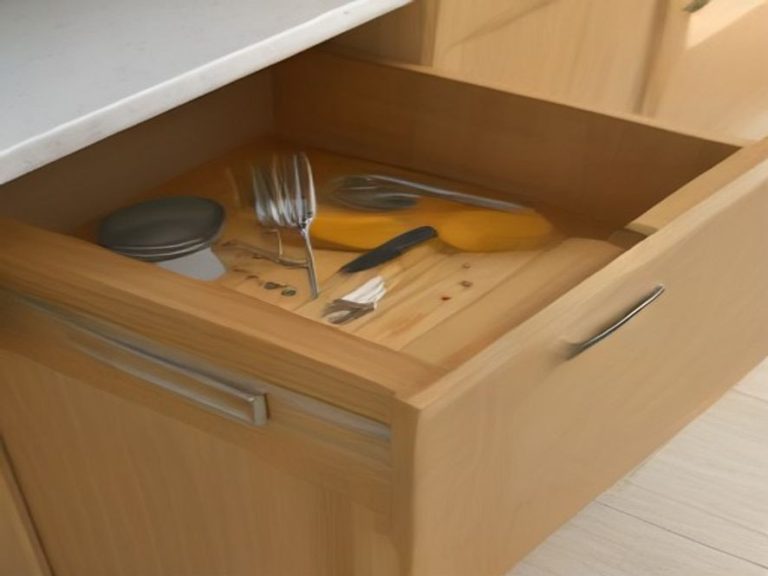
Shallow kitchen drawers often get a bad rap. They’re too short for vertical organizers, too flat for bulky items, and seem designed to make everything slide around. But here’s the secret: shallow drawers are actually the most versatile storage spaces in your kitchen when organized correctly. The trick isn’t fighting their limitations—it’s working with their natural strengths. This guide will show you practical solutions to turn those frustrating flat drawers into organized, functional spaces that make cooking easier.
TL;DR
Shallow drawers (3-4 inches deep) are best organized with flat trays and compartment dividers rather than tall bins. Start by emptying and decluttering—remove items you don’t use. Use flat utensil trays, in-drawer knife blocks, and tiered inserts for spices. Group items by category and drawer purpose. Measure before buying any organizers, and use broad categories (3-5 maximum) to make the system sustainable. A shallow drawer near your prep area can hold wraps and measuring tools, while others can store cutlery and cooking utensils.
Key Takeaways
- Measure before you buy anything—the biggest mistake is guessing drawer dimensions
- Shallow drawers need FLAT organizers—tall bins won’t fit and waste space
- Use broad categories (3-5 max) instead of trying to separate every single tool
- Consider an in-drawer knife block to free up counter space and protect blades
- Keep the junk drawer intentional—designate one drawer for miscellaneous items so chaos doesn’t spread
The Real Causes Behind Shallow Drawer Disorganization and How to Fix Them
The main challenge with shallow drawers is simple: standard organizers often don’t fit, and items slide around when you open and close them. Most shallow kitchen drawers are about 3 to 5 inches deep . This limited height means you can’t use tall bins or vertical organizers, and items have to lay flat.
Another common problem is cramming too many different types of items into a single drawer. When spatulas, measuring spoons, peelers, and miscellaneous gadgets all share the same space, finding anything becomes a treasure hunt. And without a clear system, the drawer quickly becomes a chaotic mess where items shift around every time you open it.
The solution is to match your organizing tools to the drawer’s actual depth and to create zones that make sense for how you actually cook.
Step-by-Step Guide to Maximizing Shallow Drawers
Here’s a proven approach to transforming your shallow drawers from frustrating to functional.
Step 1: Empty and Declutter Completely
Pull everything out of the drawer and put it on your counter. This is the only way to see what you actually have . While the drawer is empty, wipe it down and remove any crumbs or dust. This is also the perfect time to add a non-slip drawer liner to prevent items from sliding around.
Be ruthless about what goes back. If you haven’t used it in the past year, it probably doesn’t need to live in this drawer . Duplicate spatulas, rusty tools, and gadgets you never reach for should be donated or trashed.
Step 2: Measure Your Drawers
This step is essential. Measure the inside width, depth, and height of your drawer—not the cabinet face . Write these numbers down before shopping for any organizers. Aim for organizers that are about ½ to 1 inch smaller than your drawer dimensions so they fit without fighting the drawer slides .
Step 3: Assign Each Drawer a Purpose
Think about how you move through your kitchen. Organize by workflow, not just by category . Here are some smart zone ideas for shallow drawers:
- Drawer near the stove: Cooking utensils like spatulas, tongs, ladles, and wooden spoons
- Drawer near the prep area: Measuring tools, peelers, and small gadgets
- Drawer near the table or dishwasher: Flatware—forks, knives, spoons
- Drawer for wraps: Foil, cling film, parchment paper, and storage bags
- Dedicated spice drawer: A tiered insert so you can see every label at a glance
- Designated junk drawer: One drawer for miscellaneous items so random stuff doesn’t invade your organized spaces
Giada De Laurentiis recommends this approach, saying, “Wooden spoons should be next to the stove, the knife block should be in a drawer by the cutting boards” .
Step 4: Choose the Right Organizers for Shallow Drawers
Standard vertical bins won’t fit in shallow drawers. Instead, look for flat solutions:
Flat Utensil Trays: Bamboo or plastic trays with compartments work perfectly for shallow drawers . Choose adjustable-width models if you have multiple drawers of different sizes. Dry utensils completely before storing to prevent bamboo organizers from warping .
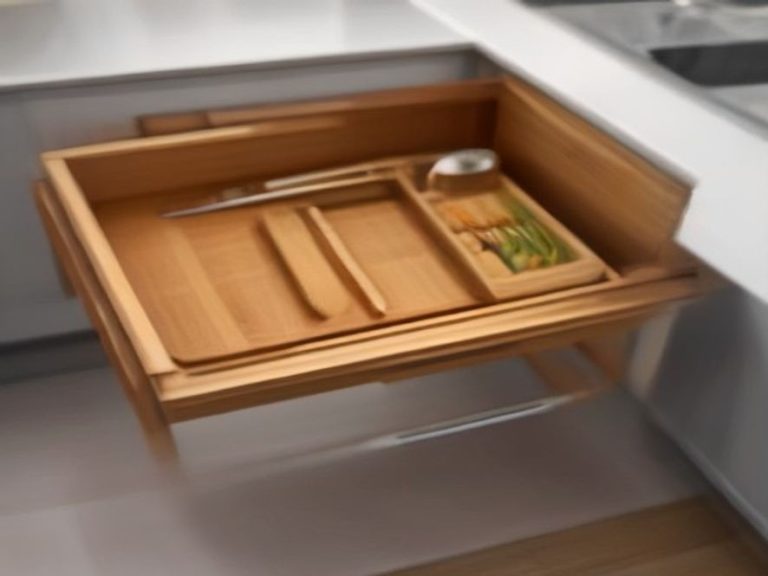
In-Drawer Knife Block: A bamboo insert with angled slots holds knives blade-down inside a shallow drawer. This replaces the countertop knife block and frees up valuable counter space . Make sure your drawer is at least 3 inches deep—chef knives won’t fit in shallower drawers .
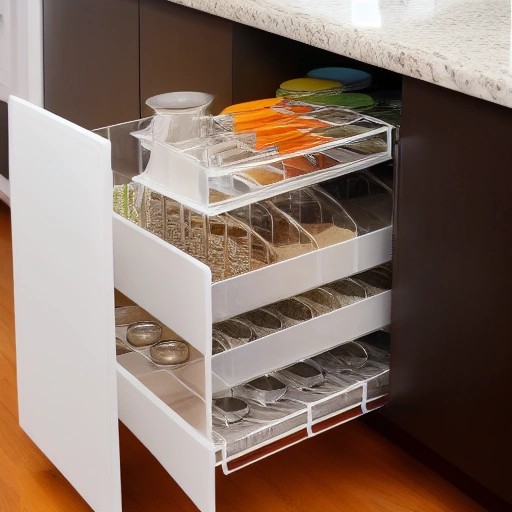
Tiered Inserts: For spices or small items, tiered organizers create layers so you can see everything at once .
Small Acrylic Containers: Clear, flat containers can be arranged to fit your drawer’s exact dimensions. They’re movable and come in various shapes and sizes .
DIY Options: If you’re on a budget, use small boxes, Tupperware lids, or cut egg cartons to create compartments for small items .
Step 5: Organize by Broad Categories
Don’t create too many categories. The more specific your system, the harder it is to maintain . Instead of separating whisks, spatulas, spoons, tongs, and peelers into individual compartments, use broad groups like “stirring tools,” “measuring tools,” and “cutting tools” .
When you’re cooking, you’re tracking multiple tasks and don’t have the mental bandwidth to figure out exactly which compartment a slotted spoon belongs in. Broad categories make it easy to put things away correctly without thinking too hard .
Step 6: Place Items Back and Test
Return items to their designated zones. The “fuller” and “tighter” your organizers and items are, the neater your drawers will stay . Items won’t shift around as much when the drawer is snugly packed.
Test the system for a week. If you find yourself constantly reaching for something in another drawer or struggling to put things away, adjust the arrangement. Organization should make your life easier, not create more frustration.
Expert Insight
“Too many categories increase friction. Is the slotted spoon a spoon or a spatula? Does the silicone scraper go with spatulas or with whisks? Successful organization uses three to five broad categories maximum.”
Comparison Table: Best Shallow Drawer Organizers
| Organizer Type | Best For | Effectiveness | Difficulty Level | Cost |
|---|---|---|---|---|
| Flat Utensil Tray | Forks, spoons, small utensils | High—Keeps items separated | Low—Just place in drawer | $$ |
| In-Drawer Knife Block | Kitchen knives (needs 3″ depth) | High—Saves counter space | Low—Place in drawer | $$ |
| Tiered Spice Insert | Spice jars, small bottles | Medium-High—Improves visibility | Low—Place in drawer | $$ |
| Small Acrylic Containers | Small items, gadgets | Medium—Flexible arrangement | Low—Can rearrange easily | $ |
| DIY Box Dividers | Small items, budget option | Medium—Requires creativity | Low—Free | Free |
| Honeycomb Dividers | Small items, unique shapes | Medium—Not fully customizable | Low—Cut to size | $ |
Frequently Asked Questions
How do I organize a shallow drawer without buying anything?
You can use old gift boxes, Tupperware lids, cut egg cartons, or smartphone boxes as DIY dividers. Use leftover yoga mat material as a non-slip liner .
What items should go in shallow kitchen drawers?
Flatware, cooking utensils, measuring spoons, peelers, spices, wraps (foil/cling film), small gadgets, and knives (in a knife block). Reserve deep drawers for bulky items like pots and pans .
How do I keep items from sliding around in shallow drawers?
Use a non-slip drawer liner, ensure organizers fit snugly, and avoid leaving empty space. The “fuller and tighter” your drawers, the less items will shift .
What is the best way to organize spices in a shallow drawer?
Use a tiered or stepped insert so you can see every label at once. This makes spices easy to find and encourages you to use them .
Should I label my shallow drawers?
Labels can help family members remember the system, especially when you first reorganize. Once everyone is used to it, you can remove them .
How many categories should I use in a shallow drawer?
Three to five broad categories maximum. Too many specific categories make the system hard to maintain, especially when you’re cooking and in a hurry .
References
Expert Sources on Shallow Drawer Organization:
- Tasting Table – Giada De Laurentiis Drawer Storage Tips
- Stylez Vault – Kitchen Drawer Organizers Guide
- Cosmo Appliances – Drawer Organization Tips
- Kitchen Clerk – How to Organize Kitchen Drawers for Daily Use
- Your Simply Home – How to Organize Shallow Drawers
Which kitchen problem do you want solved next? Share your thoughts in the comments.