Why Is My Kitchen Drawer Organizer Not Working? Common Causes and Simple Fixes
You bought a drawer organizer to bring order to your kitchen, but somehow things are more chaotic than ever.
You carefully arranged everything. It looked beautiful. Then you cooked dinner, and within a week, your spatulas are tangled with your whisks, your forks have migrated into the spoon compartment, and you’re back to digging through a mess. You’re not alone. This happens to almost everyone, and it’s rarely your fault. The problem is usually the organizer itself or how you’re using it.
TL;DR
Most drawer organizers fail because they have design flaws like incomplete dividers that let utensils slide underneath , or they demand too much precision for real-world cooking . The main fixes are: choose organizers with full dividers, use broad “zones” instead of exact slots, ensure your organizer matches your drawer depth, and group similar tools together. A $3 tension rod can be a game-changer .
Key Takeaways
- Check for design flaws: Many organizers have dividers that don’t reach the bottom, allowing silverware to slip underneath .
- Use zones, not slots: Organize by broad categories like “spatulas” or “stirring tools” instead of individual slots .
- Match depth to drawer: Shallow organizers in deep drawers invite hidden layering of items underneath .
- Keep it simple: Three to five broad categories are easier to maintain than ten specific compartments .
- Measure tools separately: Measuring cups and spoons belong near your prep area, not with cooking utensils .
The Real Reasons Your Drawer Organizer Keeps Failing and How to Fix Them
Flawed Design: When the Organizer Itself Is the Problem
A lot of organizers look great in pictures but have hidden design flaws. One of the most common issues is incomplete dividers. The dividers you see on top don’t actually go all the way down to the bottom of the organizer .
This means your silverware can slide underneath the divider and end up tangled in the next compartment . Some customers have reported their utensils ending up horizontal or jamming the drawer because the divider allows items to migrate from one slot to another . One frustrated reviewer said, “I had to take everything out to try and retrieve the lost” silverware .
The Fix: Look for organizers with dividers that extend all the way to the base. If you already own one with this flaw, consider using it for non-kitchen items like office supplies.
The Perfect Fit Problem: Precision Organizers Don’t Work in Real Kitchens
Those organizers with a perfectly-sized slot for every single utensil? They look amazing in “before and after” photos, but they’re a nightmare in real life .
They demand exact placement every single time . The whisk only fits at a specific angle. The slotted spoon has to go in handle-first. When you’re in the middle of cooking, watching three things on the stove, your mental bandwidth for “which angle does the fish spatula go in at” is approximately zero .
As one expert puts it, “The tighter the fit, the more frustrating the system” . When you buy a new tool, there’s suddenly no designated spot for it. So it gets tossed wherever it fits, and the whole system unravels.
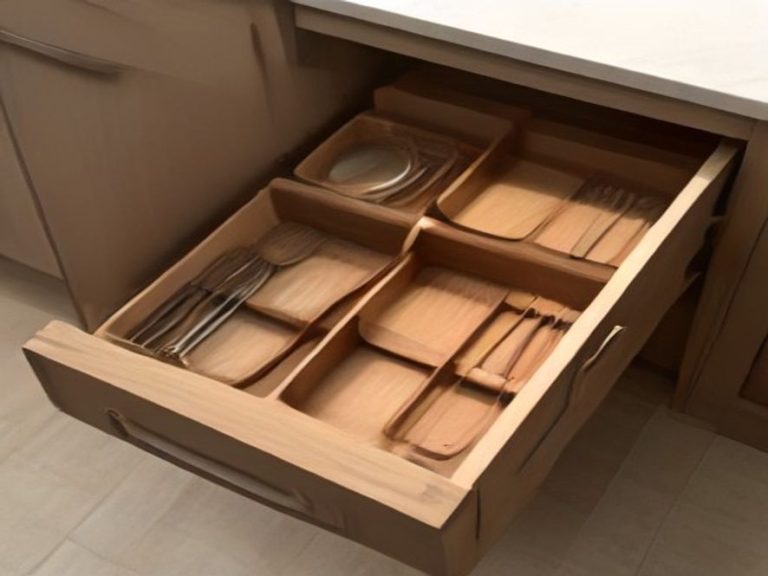
The Fix: Organize by zones, not individual slots . Instead of a slot for each type of spatula, have a “spatula zone” where all spatulas go. Use wide compartments that hold multiple similar items. You’re dropping things into a zone, not threading them into a specific hole .
The Depth Mismatch: Hiding Chaos in Plain Sight
If your organizer sits shallow in a deep drawer, you’re inviting trouble . That gap underneath becomes tempting storage for overflow items. First, you slide a new gadget under there. Then another. And another. Within weeks, you have a hidden layer of chaos beneath your organized surface .
“The goal is making layering physically impossible, not relying on your future self to resist temptation” .
The Fix: Use organizers that fill the full depth of your drawer, or choose tall bins that prevent items from slipping underneath. Alternatively, reserve deep drawers for large items that actually need the space, like serving utensils or bulky tools, and use shallow drawers for cutlery and small gadgets .
Too Many Categories: The Decision Fatigue Problem
You might be trying to be too organized. If you have separate compartments for whisks, spatulas, spoons, tongs, peelers, zesters, and measuring spoons, you’ve created a puzzle .
Where does a slotted spoon go? Is it a spoon or a spatula? Where does a silicone scraper belong? These ambiguous items bounce between categories, creating placement inconsistency . When you’re rushing, you don’t have time for this decision-making. So items just get shoved anywhere.
The Fix: Stick to three to five broad categories. For example: “stirring tools,” “measuring tools,” “cutting tools,” and “miscellaneous” . Broad categories forgive mistakes.
Step-by-Step Fix Guide: Making Your Drawer Organizer Work
Step 1: Empty and Declutter
Take everything out of the drawer . Give it a good wipe. Sort everything into piles: keep, donate, and trash. Get rid of duplicates and items you haven’t used in a year. A malformed whisk you inherited? Toss it. An analog meat thermometer rusting since the Clinton administration? Throw it out .
Step 2: Categorize Your Tools
Group similar items together. The goal is to make things easy to find and return. Grouping similar items makes it faster to find and return tools after use .
Step 3: Create Simple Zones
Assign a purpose to each drawer and each zone within that drawer. One drawer for cutlery, one for cooking tools, one for gadgets . Within the cooking tools drawer, have a zone for spatulas, a zone for whisks, and a zone for tongs. Keep the categories broad. For example, “stirring tools,” “cutting tools,” and “miscellaneous” works better than ten specific categories .
Step 4: Choose the Right Organizer
- For cutlery: Look for dividers that go all the way to the base.
- For deep drawers: Use tall bins or organizers that fill the depth to prevent layering .
- For cooking tools: Use wide compartments, not tight slots. Think of them as “drop zones.”
- Pro tip: A $3 tension rod can be a game-changer for creating custom dividers in a drawer .
Step 5: Use Broad Categories
These are all you need :
| Category | Examples |
|---|---|
| Stirring Tools | Spatulas, wooden spoons, whisks, ladles |
| Cutting Tools | Peelers, graters, knives, scissors |
| Measuring Tools | Measuring cups, measuring spoons |
| Miscellaneous | Corkscrews, jar openers, zesters |
Step 6: Keep Measuring Tools Separate
Measuring tools are used during prep, before cooking even starts. Cooking tools are used at the stove during active cooking . Mixing them in the same drawer means you’re constantly moving between different areas of the kitchen. Keep measuring tools in a drawer near your prep area and cooking tools near your stove .
Comparison Table: Organizer Types and When to Use Them
| Organizer Type | Best For | Effectiveness | Why It Works or Fails |
|---|---|---|---|
| Precision Slotted Organizer | Utensils that are all the same size and shape | Low | Fails because it demands exact placement and doesn’t accommodate new tools |
| Wide-Compartment Organizer | Spatulas, serving spoons, tongs | High | Works because it uses “zones,” allowing for imperfect returns |
| Full-Depth Organizer | Deep drawers | High | Prevents layering and hidden chaos underneath |
| DIY Dividers | Customizable storage | Medium-High | Uses items like small boxes to create flexible zones |
| Drawer-Specific Organizer | Silverware, cutlery | High (if dividers are complete) | Check for dividers that go all the way down |
FAQ: Your Drawer Organizer Questions Answered
1. Why does my silverware get mixed up in my organizer?
This is usually a design flaw. Many organizers have dividers that stop at the top, allowing utensils to slide underneath into the next compartment . Look for organizers with full dividers that reach the bottom.
2. Why can’t I keep my cooking tools organized?
You might be using an organizer with too many tight slots. These demand precise placement, which is impossible when you’re rushing . Switch to a zone system with broad categories.
3. What’s the best way to organize deep drawers?
Use organizers that are tall enough to fill the depth or use bins that prevent items from being layered underneath. Otherwise, items accumulate beneath the organizer .
4. Where should I store measuring cups and spoons?
Store them in a drawer near your prep area, separate from cooking utensils. This puts them where you need them during prep and avoids clutter near the stove .
5. How many categories should I have in a drawer?
Stick to three to five broad categories maximum. This reduces decision-making and makes it easier to put items away quickly .
6. Should I label my drawer sections?
Yes! Especially when you’re transitioning to a new system. Labels help everyone in the household remember where things go .
7. What’s the cheapest way to fix a messy drawer?
Use small boxes, old gift boxes, or phone boxes as DIY dividers. A tension rod can also create a custom section for a few dollars .
The problem probably isn’t you. Your organizer might just have a design flaw or be the wrong type for your habits and drawer size. With a few simple fixes, you can have a drawer that works with you, not against you.
Which kitchen problem do you want solved next? Share your thoughts in the comments.
Practical Tips for Kitchen Drawer Organization and Troubleshooting: