How to Fix a Black Hole Junk Drawer: A Guide to Organizing Without Losing Your Mind
That feeling when you open your “junk drawer” and a tsunami of pens, packets, and mystery keys spills out—and you still can’t find the scissors—is exactly what this guide will help you fix.
We all have one. It’s the drawer where kitchen utensils go to mingle with old receipts, dead batteries, and enough takeout menus to wallpaper a small room. The junk drawer is a household staple, but it doesn’t have to be a source of daily frustration. The good news is that you can tame this chaos without throwing away everything you own. The secret isn’t getting rid of all your odds and ends; it’s about giving them a proper, logical home within that one special drawer.
TL;DR
A junk drawer becomes chaotic because items are added without a system. The fix is simple: empty it completely, sort everything into clear categories, and be ruthless about removing trash and relocating items that belong elsewhere. A physical organizer is key to keeping it tidy. The final step is committing to a quick monthly reset to prevent the clutter from creeping back. The goal is a drawer of genuinely useful items you can actually find.
Key Takeaways
- Start with a blank slate—empty the drawer completely before you do anything else
- Sort into four groups: keep, relocate, trash, and donate
- Be ruthless with duplicates, expired items, and broken tools
- Use an organizer or dividers to create defined sections that prevent chaos from returning
- Maintain with a monthly 5-minute tidy to catch clutter before it builds up
The Real Cause Behind Junk Drawer Chaos and How to Fix It
The junk drawer isn’t a villain. It’s actually a very useful feature—a designated spot for those odd items that don’t have a logical home anywhere else . The problem starts when that drawer becomes the default drop zone for everything that doesn’t have an immediate place. A stray screw from a project, a handful of loose change, a collection of pens that may or may not work—they all find their way in.
A professional organizer explains that the junk drawer’s issue isn’t the miscellaneous items themselves; it’s that the layer of stuff becomes so thick you can’t find anything without a full excavation . The solution is to rebuild the drawer around a simple principle: only keep items that serve a purpose and belong together.
The process is easier than you think. You can use a structured method like the “Core 4” (Clear Out, Categorise, Cut Out, and Contain) or the “SIMPLE” method (Sort, Identify, Make a home, Put it in containers, Label it, Establish a routine) to make the task feel less daunting .
The 4-Step Fix to Organize Your Junk Drawer
Here’s a proven, no-nonsense approach to turning your junk drawer from a disaster zone into a functional space.
Step 1: Empty It Completely
This is the most critical step. Do not attempt to organize the drawer while items are still inside. In-place sorting often just rearranges the mess . Pull the entire drawer out and dump all its contents onto a clear surface like your kitchen table or countertop . This gives you a bird’s-eye view of the situation and forces you to handle each item individually. It’s also the perfect time to clean the empty drawer, shaking out crumbs and wiping it down .
Step 2: The Great Sort
Now, with everything spread out, you can sort. Create piles based on a simple system. Many experts recommend using four main categories :
- Trash: This is the easiest pile. Broken pens, dried-out markers, expired batteries, old receipts, empty packets, and single-use plastic cutlery that has seen better days .
- Relocate: This pile is for items that are useful but don’t belong in this specific drawer. A screwdriver should be in the toolbox, extra lightbulbs in the utility closet, and your child’s favorite toy in their room .
- Donate/Give Away: This is for items that are in good condition but that your household simply doesn’t need. Maybe you have three pairs of scissors .
- Keep: These are the items that make the cut and will actually live in the drawer. This should be a surprisingly small pile .
Pro Tip: If you’re feeling overwhelmed, try the “Take 10 Away” method, where you commit to finding just 10 items to remove from the drawer each day until it’s done .
Step 3: Define and Contain
Now that you know what’s staying, it’s time to organize them by category. Group similar items together: a pile for pens, a pile for tape, a pile for batteries . This is where you become the architect of your drawer.
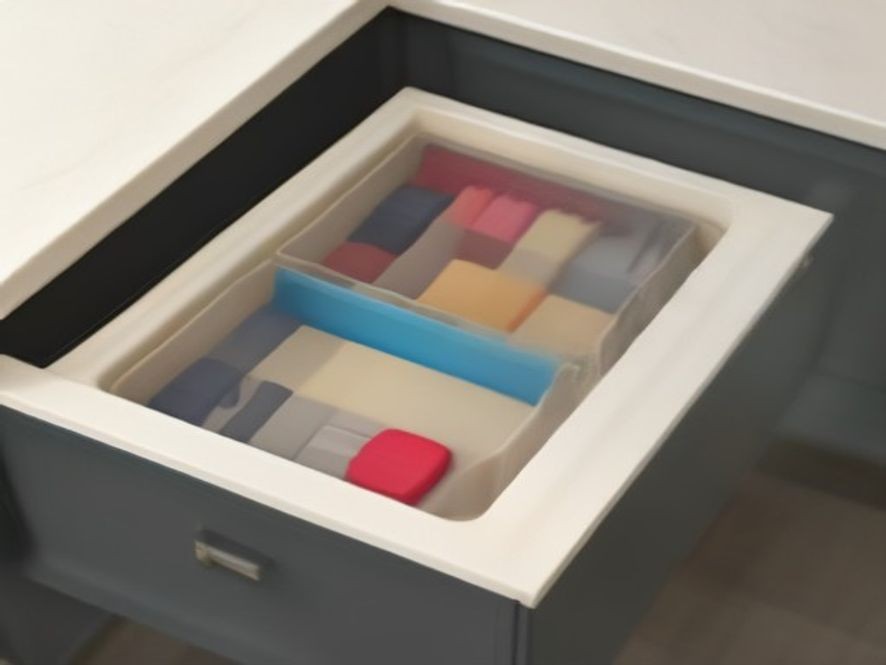
To prevent these piles from becoming one chaotic mess again, you need an organizing structure. An empty, undivided drawer invites chaos . This structure doesn’t have to be expensive.
- Buy an organizer: You can find multi-section drawer organizers at almost any store. Look for one that fits your drawer’s measurements .
- DIY a solution: For a cheap and custom fit, you can create dividers using foam board from a dollar store or even sturdy cardboard . You can cut them to size and slot them together to create compartments that perfectly fit your items.
- Repurpose containers: Small boxes, like the ones that phones come in, are excellent for tiny items like rubber bands or paper clips .
Step 4: Assign a Home and Place Items Back
Place your organizers in the drawer. Now, assign each category to its own “compartment.” Put the office supplies in one section, the fast-fix solutions in another .
Here’s a snapshot of what a well-organized junk drawer typically contains :
| Item Category | Examples |
|---|---|
| Writing Utensils | A few pens that actually work, a pencil, a highlighter |
| Tape & Adhesives | A roll of tape, superglue |
| Small Tools | A small screwdriver, a tape measure |
| Utility Items | Batteries for the remote, a small flashlight |
| Office Supplies | A notepad, stamps |
| Kitchen Odds & Ends | A wine stopper, a meat thermometer |
Expert Insight
“A junk drawer without a physical organizer inside will refill with the same mix of miscellaneous items within a few months. A divided drawer tray creates visual sections that make items easier to find and add subtle friction to casual additions.”
Frequently Asked Questions
How do I organize a junk drawer without buying anything?
You can use items you already have, like old jewelry boxes, clean food containers, or sturdy cardboard. Cut cardboard into strips to create a custom divider system for free .
Why does my junk drawer get messy again so fast?
Without an organizer or a clear “home” for each item, it’s too easy to just toss things in. The key is to define sections and regularly do a quick tidy-up .
What should I actually keep in my junk drawer?
Keep items that are genuinely useful and don’t have a better home elsewhere. This includes a few pens, tape, scissors, a small screwdriver, batteries, and a notepad .
How often should I clean my junk drawer?
A full purge once a year is great, but a quick 5-minute tidy once a month will keep it from becoming chaos again. Use this time to remove trash and put stray items back in their spots .
What is the best way to sort a junk drawer?
Empty it completely and sort everything into piles: keep, relocate, trash, and donate. Be ruthless—if you haven’t used it in a while, it’s probably just taking up space .
How do I get my family to stop putting random stuff in the junk drawer?
Explain the new system to everyone. Label the sections if it helps. Make it easier to put things away correctly than to just drop them in. If you have a lot of clutter, try the “Core 4” method or the “SIMPLE” method as a guideline.
References
Expert Sources on Junk Drawer Organization:
- Apartment Therapy – Pro Organizer Junk Drawer Fix
- Good Housekeeping – Core 4 Declutter Method
- MinimalistRig – Decluttering Your Junk Drawer
- Molly Maid – How to Organize Your Junk Drawer and Keep It Organized
- Better Homes & Gardens – How to Clean Out Your Junk Drawer
Which kitchen problem do you want solved next? Share your thoughts in the comments.