How to Organize a Kitchen Drawer for Knives Without Wasting Space: Best Guide & Smart Storage Solutions
That cluttered drawer where knives clang against each other every time you open it is not only annoying—it’s dangerous for your fingers and your blades.
You’re reaching for a paring knife, and your hand brushes against a chef’s knife blade. It’s a moment of panic that nobody wants in their kitchen. If you’re tired of bulky knife blocks hogging counter space and loose knives creating a hazard, you’re in the right place. This guide shows you the best way to fix that messy drawer, keep your knives safe and sharp, and reclaim every inch of space.
TL;DR
Organizing your knives in a drawer is the smartest way to save counter space and keep blades protected. The best solutions use in-drawer knife organizers—either slotted blocks or tiered racks—that hold knives securely while taking up minimal space. By choosing the right organizer and following a few simple tips, you can transform a cluttered drawer into a safe, efficient storage zone.
Key Takeaways
- Ditch the countertop knife block: Moving knives into a drawer frees up valuable counter space and keeps them out of sight .
- Choose the right organizer: Options include traditional slotted blocks, tiered two-level designs for more knives, and even modular magnetic systems .
- Measure your drawer first: Check the length, width, and height to ensure any organizer fits comfortably .
- Place blades facing up: This helps keep the sharp edge from pressing against the slot and blunting the knife .
- Secure the organizer: Non-slip feet or a mat underneath prevent the organizer from sliding around when you open the drawer .
The Real Causes Behind a Messy Knife Drawer
The root of the problem is often a mixture of too many tools and no proper system. When knives are tossed in a drawer without a designated spot, they slide around, bump into each other, and can cause two major issues. First, the blades get dull faster from all the knocking around. Second, it’s a serious safety hazard—you can easily cut yourself reaching past a loose blade .
Another common culprit is holding onto old knife blocks that take up precious counter space. While they’re a classic way to store knives, they can be bulky and limit your workspace . The solution is to put that space to better use and move your knives into a dedicated drawer organizer.
Step-by-Step Guide: How to Organize Your Knife Drawer
Ready to fix your knife drawer once and for all? Here’s a step-by-step guide to get it done.
Step 1: Empty and Declutter
Pull everything out of the drawer. This isn’t just about your knives—it’s about seeing the whole picture. Take inventory of your knives. Do you have duplicates? Are there any that are damaged beyond repair? This is the time to be honest. Keep only the knives you actually use regularly.
Step 2: Measure Your Drawer
This is a non-negotiable step. Before you buy any organizer, grab a tape measure and note the length, width, and depth of your drawer . Many organizers require a minimum drawer height to fit properly, often around 3 inches . Knowing these numbers will save you from the frustration of an organizer that doesn’t fit.
Step 3: Choose the Right Organizer
This is where you decide on the solution that fits your drawer and your knife collection.
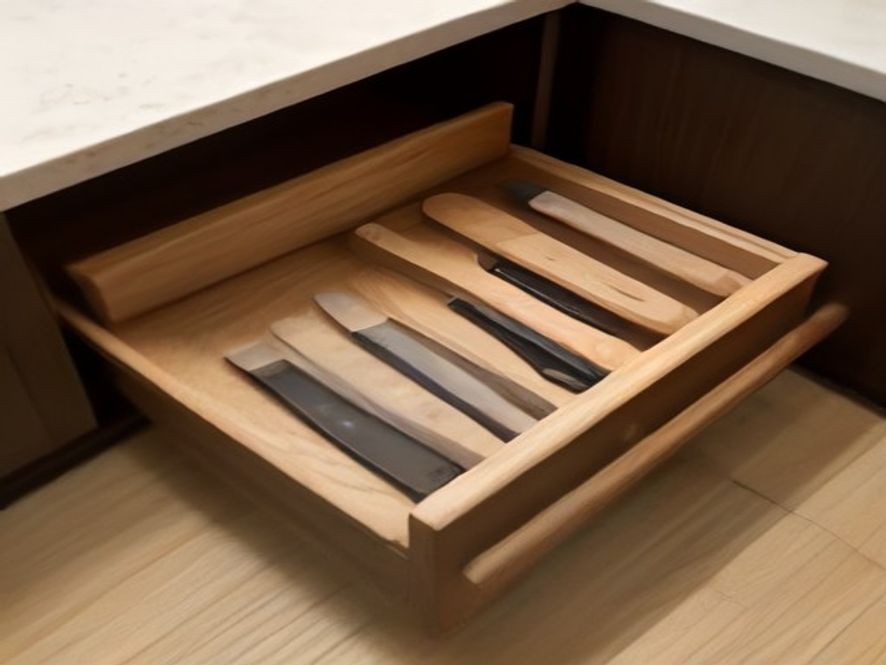
- In-Drawer Slotted Knife Block: This is the most common type. It holds knives upright in individual slots, protecting the blades and keeping them organized. They come in wood, like the popular walnut and maple options , or durable, easy-to-clean plastic . They fit a wide range of drawer sizes .
- Tiered or Compact Organizers: For deeper drawers, these are a game-changer. They feature two levels of slots, allowing you to store more knives—sometimes up to 9 or even 11—without taking up much extra length .
- Multi-Purpose Trays: If you have a smaller drawer and want to store knives alongside other utensils, look for a divided organizer. Some feature a small knife block built in, with separate compartments for silverware or other tools .
- Modular Magnetic Systems: A newer option, these are small, independent blocks that use magnets to hold knives securely. They are versatile and can be combined to fit your exact collection and drawer space .
Step 4: Organize and Place
Once you have your organizer, it’s time to put everything in its place. Start by arranging your knives. A good tip is to place the sharp edge of each blade facing up . This helps keep the blade’s edge from being pressed against the slot, which can make it dull. Also, stagger your knives by alternating larger chef’s knives with smaller paring knives to make the handles easier to grab .
Step 5: Secure the Organizer
The last thing you want is for your organizer to slide around every time you open the drawer. Many organizers come with non-slip feet . If yours doesn’t, you can place a non-slip mat underneath it or stick small silicone pads to the bottom .
Comparison Table: Best Knife Drawer Organizers
| Organizer Type | Best Used For | How It Saves Space | Difficulty Level | Cost |
|---|---|---|---|---|
| Slotted Knife Block | Storing up to 7-9 knives securely | Narrow footprint that fits most standard drawers | Easy | Low to Medium |
| Tiered Organizer | Maximizing storage with up to 11 knives, perfect for deep drawers | Two-tier design holds more knives in the same length | Easy | Medium |
| Multi-Purpose Tray | Small drawers needing to store knives plus other utensils | Combines knife storage with silverware compartments | Very Easy | Low |
| Modular Magnetic Set | Custom collections; allows flexible drawer layouts | Small individual blocks can be rearranged to fit | Easy | Medium to High |
Chart: Comparison of Knife Drawer Organizer Efficiency
This chart compares how much space you can save in a drawer when using different types of organizers.
Space Efficiency Comparison: Knife Drawer Organizers
FAQ
Why shouldn’t I just leave my knives loose in a drawer?
Leaving knives loose is a safety hazard and can damage the blades. They can shift and cause you to cut yourself, and the blades will get dull from knocking against other items .
What is an in-drawer knife block?
It’s an organizer that holds your knives securely in a kitchen drawer, protecting the blades and keeping them organized and out of sight .
How do I know if a knife organizer will fit my drawer?
Always measure your drawer first. Note the length, width, and most importantly, the height. Many organizers need a minimum drawer height, such as 3 inches .
What’s the best way to keep my knife organizer from sliding?
Many organizers come with non-slip feet. If yours doesn’t, place a non-slip mat underneath it to prevent it from moving when you open the drawer .
Is a wooden or plastic knife organizer better?
Wooden organizers, like those made of bamboo or walnut, look great but can be harder to clean and may absorb moisture . Plastic organizers are typically dishwasher-safe and easier to maintain .
Can I store other items in the same drawer as my knives?
Yes, you can. There are multi-purpose trays that combine a knife block with compartments for silverware, or you can place smaller organizers next to your knife block in a wide drawer .
Did this guide help you think about organizing your knife drawer? What other kitchen challenges are you facing? Let us know in the comments below!
Smart Kitchen Organization: Tips and Solutions for a Functional Cooking Space: