How to Organize a Kitchen Drawer for Pot Holders and Kitchen Towels
A messy drawer full of tangled pot holders and mismatched kitchen towels can turn a simple cooking task into a frustrating scavenger hunt.
You’re in the middle of cooking, and you need a pot holder to grab that hot cast iron skillet. You yank open the drawer, and a cascade of towels, oven mitts, and crumpled cloths spills out. Suddenly, you’re juggling a hot pan while trying to untangle a pot holder from a dish towel. This daily annoyance can make your cooking space feel chaotic and even dangerous. But what if you could fix this problem in just one afternoon? This guide will show you exactly how to organize a kitchen drawer for pot holders and kitchen towels, creating a safe, functional system that actually stays neat.
TL;DR (Too Long; Didn’t Read)
A cluttered drawer full of bulky textiles is often caused by overstuffing and folding everything the same way. The best way to fix this is to empty the drawer, sort your items by size and purpose, and use adjustable dividers or tension rods to create designated zones. The key is to fold towels uniformly and store pot holders flat or upright, making every item visible and easy to grab without making a mess.
Key Takeaways
- Declutter Without Mercy: Toss stained, frayed, or worn-out towels and pot holders. You likely have more than you need.
- Sort by Purpose: Separate everyday towels from fancy guest towels, and pot holders from oven mitts based on their heat protection level.
- Use Vertical Dividers: Adjustable dividers are the most effective way to stop towels from sliding around and mixing together.
- Try Tension Rods: For deep drawers, small tension rods can create instant, custom compartments for rolled towels.
- Fold Uniformly: The “file folding” method (standing towels upright like files) is a game-changer for visibility and space efficiency.
The Real Causes Behind a Chaotic Towel Drawer and How to Fix Them
Why do our kitchen drawers become a messy jumble of fabric? It usually comes down to a few common kitchen organization mistakes.
First, many of us treat this drawer as a catch-all. We toss in oven mitts, pot holders, dish towels, and bar mops without any system. Without clear boundaries, everything migrates and tangles every time the drawer opens and closes.
Second, we often overstuff the drawer. It’s easy to accumulate towels over the years—gifts, holiday prints, souvenirs from trips. But a drawer packed too full makes it impossible to grab one item without pulling out five others. This leads to frustration and wrinkled, messy-looking towels.
Third, most people fold towels differently. Some fold in thirds, others in half, and some just ball them up. This inconsistency creates a lumpy, uneven pile that wastes space and looks chaotic.
The Hidden Danger of a Messy Towel Drawer
There’s also a safety concern hiding in that cluttered drawer. Pot holders and oven mitts are essential for kitchen safety—they protect your hands from burns when handling hot pans, baking sheets, and cast iron. When they’re buried under a pile of towels, you might grab a thin dish towel instead, thinking it’s a pot holder. This is a serious burn risk.
Important safety reminder: Always use proper pot holders or oven mitts when handling hot cookware. A dish towel is not a safe substitute for heat-resistant protection.
How to Fix a Chaotic Pot Holder and Towel Drawer
Fixing this problem is simpler than you might think. Here’s a step-by-step guide to creating a drawer that works for you, not against you.
Step 1: Empty Everything and Take Inventory
Pull every single item out of the drawer. This gives you a clean slate and a clear picture of exactly what you’re dealing with. As you remove each item, inspect it honestly.
Ask yourself these questions:
- Is this stained, frayed, or torn? If yes, toss it or repurpose it as a cleaning rag.
- Have I used this in the past six months? If not, donate it or move it to a less accessible location.
- Do I have three of the same thing when I only need two? Keep your favorites and let the extras go.
“Most kitchen problems come from small maintenance habits that are often ignored. Your towel drawer is no exception.”
Step 2: Sort Into Logical Groups
Now that you have a pile of keepers, it’s time to sort them by purpose. This is the foundation of your new system.
Group 1: Heat Protection (High Heat)
- Pot holders (square quilted ones)
- Oven mitts (the long ones that protect your forearms)
- Trivets (for placing hot pots on the counter)
Group 2: Drying and Wiping (Low to Medium Heat)
- Dish towels (for drying clean dishes and hands)
- Bar mops (for wiping counters and spills)
- Flour sack towels (all-purpose kitchen workhorses)
Group 3: Decorative or Guest Towels
- Fancy or seasonal towels meant for display
- Towels you only use when guests visit
Step 3: Choose Your Organization Method
Now that you have your groups, you need a way to keep them separated. Here are the most effective kitchen solutions for this specific drawer type.
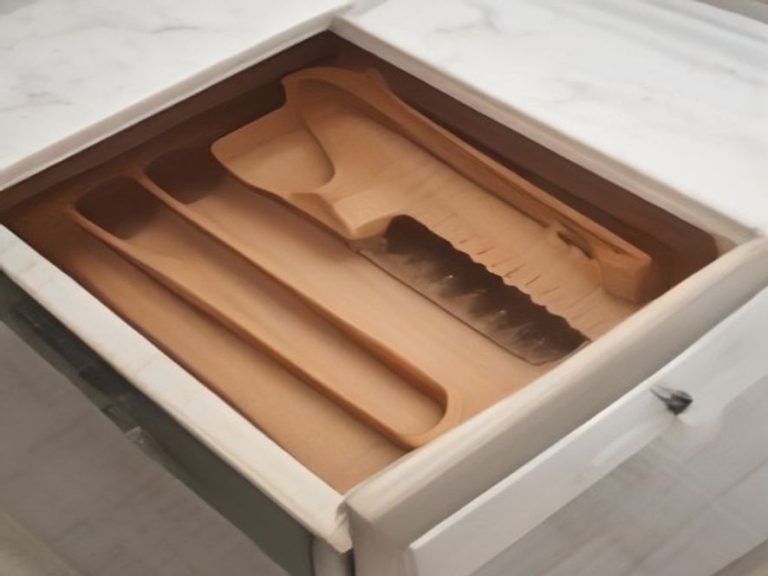
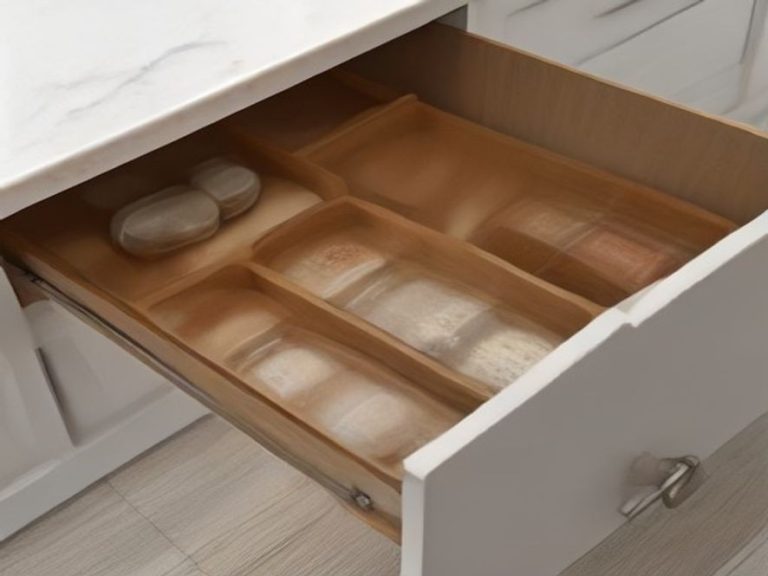
Method A: Adjustable Drawer Dividers (Best Overall)
This is the gold standard for drawer organization. Adjustable dividers expand to fit your drawer perfectly and create custom-sized compartments for each group.
How to do it:
- Measure your drawer’s inside width and depth.
- Install dividers to create sections: one for pot holders/oven mitts, one for dish towels, one for bar mops.
- Within each section, fold your items uniformly and stand them upright like files.
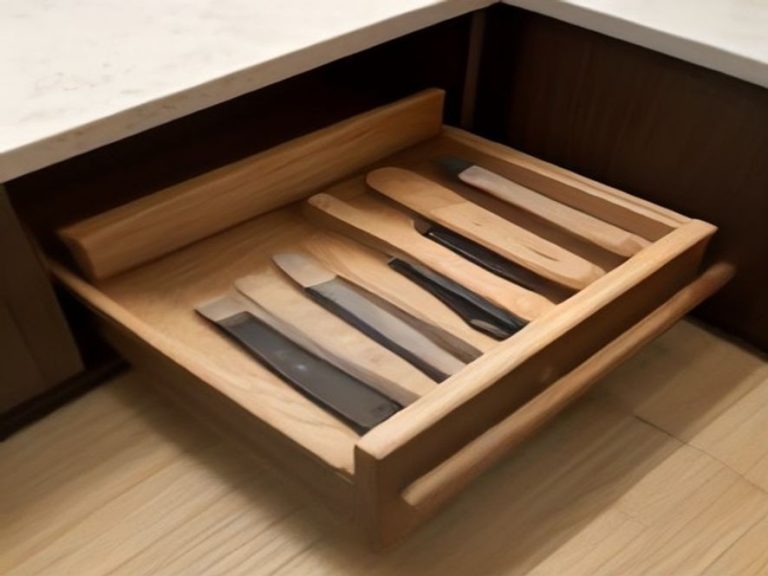
This “file folding” method is a game-changer. Instead of stacking towels flat on top of each other (where you can only see the top one), you stand them on their edges. This way, you can see every single towel at a glance and grab the one you need without disturbing the others.
Method B: Tension Rods (Budget-Friendly Genius)
For deep drawers, small tension rods (the kind used for shower curtains or window curtains) can create instant, customizable dividers.
How to do it:
- Measure your drawer width.
- Install 2-3 tension rods vertically (front to back) to create long channels.
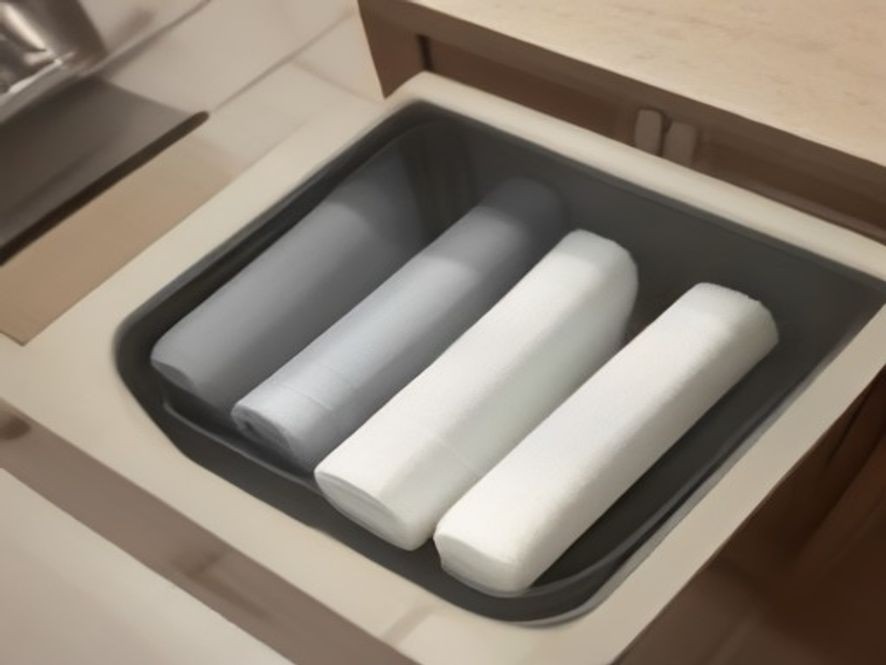
- Roll your dish towels and bar mops tightly and stand them upright in these channels.
- Place pot holders flat in a separate section.
This method is incredibly effective and costs just a few dollars. The tension rods hold the rolled towels firmly in place, preventing them from sliding around when the drawer opens and closes.
Method C: Bins and Containers (Simple and Flexible)
Small plastic or wire bins are another great option, especially if your drawer is shallow.
How to do it:
- Find bins that fit inside your drawer.
- Designate one bin for pot holders, one for dish towels, one for bar mops.
- Fold towels to fit the bin’s dimensions and stack them vertically.
This method is flexible—you can easily remove the bins for cleaning or reorganizing. Plus, it prevents the “everything migrates” problem that happens in open drawers.
Step-by-Step Guide to the “File Folding” Towel Method
This technique is so effective, it deserves its own section. Here’s exactly how to do it.
- Fold the towel in half lengthwise (so the long edges meet).
- Fold in half again (so the short edges meet). You now have a rectangle.
- Fold in thirds (like folding a letter). The final size should be about 5-7 inches wide and 8-10 inches tall—roughly the size of a standard magazine.
- Stand the folded towel upright in your drawer, like a file folder.
This consistent fold means every towel is the same size, so they fit neatly together. You can line them up like books on a shelf, and you can instantly see every design and color.
What About Pot Holders?
Pot holders are bulkier than towels. Here’s how to handle them:
- Option 1: Store flat. Place them in a shallow bin or section, stacked flat. This works well if you have a dedicated, shallow drawer.
- Option 2: Store upright. Fold them in half, then roll them. Place them upright in a container or between dividers.
- Option 3: Hang them. Install a small hook inside the cabinet door above your drawer and hang pot holders there. This frees up valuable drawer space entirely.
Your Towel Drawer Organization Plan: A Quick Comparison
| Method | Purpose | Effectiveness | Difficulty | Cost |
|---|---|---|---|---|
| Adjustable Dividers | Create custom zones for each group. | Very High | Low | $$ |
| Tension Rods | Create instant channels for rolled towels. | High | Very Low | $ |
| Small Bins/Containers | Flexible compartments that are easy to remove. | Medium-High | Very Low | $-$$ |
| Hanging Pot Holders | Free up drawer space entirely. | High | Medium | $ |
Frequently Asked Questions (FAQs)
How do I organize a deep drawer for pot holders and towels?
For deep drawers, vertical storage is the best solution. Use tension rods or adjustable dividers to create channels where you can roll or file-fold your towels upright. This doubles your capacity and makes everything visible.
What is the best way to fold dish towels for a drawer?
The “file folding” method is the most space-efficient and visually clear. Fold towels into uniform rectangles (about 5-7 inches wide) and stand them upright like files.
How do I store oven mitts in a drawer?
Oven mitts are bulky. Store them flat in their own section, or hang them on a hook inside a cabinet door to save drawer space. If you must keep them in the drawer, stand them upright between dividers.
How do I stop towels from sliding around in the drawer?
The most effective solution is using adjustable dividers or tension rods to create snug compartments. Non-slip drawer liners also help grip the fabric and prevent sliding.
How often should I replace kitchen towels?
Replace kitchen towels when they become frayed, stained, or worn thin. Regular kitchen cleaning and maintenance means washing towels frequently and retiring them as soon as they start to degrade. Usually, towels last 1-2 years with regular use.
Should I keep decorative towels in the same drawer as everyday towels?
It’s better to separate them. Keep everyday towels in your primary, easily accessible drawer. Store decorative or guest towels in a less accessible spot, like a linen closet or a separate drawer.
Can I use a tension rod in a shallow drawer?
No, tension rods require some depth to hold items upright. For shallow drawers, use flat dividers or small bins to keep items separated.
Preventing Future Clutter
Once you have your beautiful, organized drawer, the goal is to keep it that way. Here are a few simple habits to maintain your new system:
- One in, one out. When you buy a new kitchen towel, donate or toss an old one. This keeps your collection manageable.
- Fold as you put away. Resist the urge to just shove a clean towel into the drawer. Take the extra 10 seconds to fold it properly and “file” it in its place.
- Do a seasonal check. Every few months, do a quick review of your drawer. Are there any towels that need replacing? Has your collection grown too large?
- Keep extras elsewhere. You don’t need 20 everyday towels in your primary drawer. Keep a smaller, daily rotation in your main drawer and store the rest in a nearby cabinet or closet.
Regular kitchen maintenance and organization habits prevent clutter from building up again. A clean, tidy drawer makes cooking safer and more enjoyable.
Which kitchen drawer is giving you the most trouble? Do you have a system for pot holders or towels that works great? Share your thoughts and questions in the comments below!
Learn More: Smart Kitchen Organization and Safety Tips