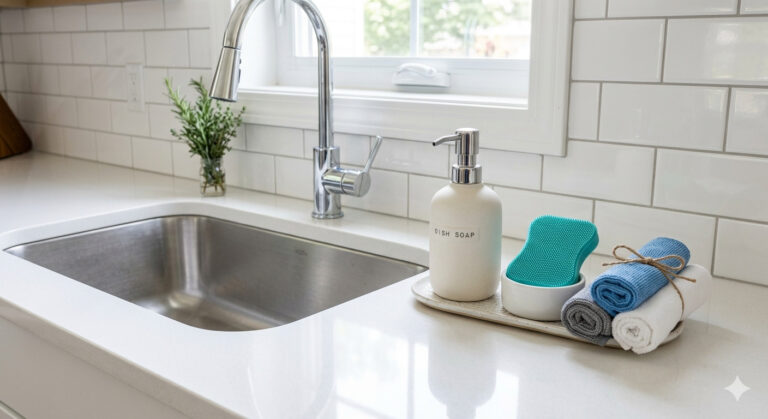
How to Remove Bad Smell From Kitchen Permanently: Complete Kitchen Cleaning Guide
You walk into your kitchen after a long day, and that same stale, musty smell hits you — the one you thought you eliminated last week when you scrubbed the counters and took out the trash. It is back, and it is worse than ever.
TL;DR
Bad kitchen smells come back because you are masking them instead of removing the source. Permanent odor elimination requires a five-layer system: remove the source (trash, old food, dirty dishes), neutralize airborne particles (simmering vinegar), deep clean surfaces (degrease walls and cabinets), flush drains (baking soda and vinegar), and maintain ventilation (range hood and open windows). This guide gives you a complete system that attacks odors at their origin, not just on the surface. Follow it once, and your kitchen will stay fresh permanently.
Key Takeaways
- Air fresheners and candles do not remove odors — they just add perfume on top of the smell. The odor is still there.
- Most kitchen odors come from five places: trash can, sink drain, garbage disposal, refrigerator, and greasy surfaces.
- Vinegar is your best weapon because it chemically neutralizes alkaline odor compounds (fish, garbage, bacteria) instead of just covering them up.
- Grease traps odors. If your kitchen still smells after cleaning everything, you have grease buildup on walls or the range hood.
- A daily 5-minute routine prevents 90 percent of kitchen odors before they start.
Why Bad Smells Keep Coming Back
You clean the counter. You take out the trash. You spray air freshener. The smell goes away for an hour, then returns.
Here is why.
Air fresheners do not remove odors. They overwhelm your nose with perfume. When the perfume fades, the original odor molecules are still floating in the air and sitting on your surfaces.
Odors hide in places you forget. The garbage disposal rubber splash guard. The refrigerator drip pan. The range hood filter. The P-trap under the sink. The top of the refrigerator. These spots collect food, grease, and moisture — the perfect environment for odor-causing bacteria.
Grease traps smells. When grease builds up on your walls, cabinets, and range hood, it acts like a sponge for odor particles. Even after you clean the sink and take out the trash, the grease slowly releases trapped smells back into your kitchen.
The only permanent fix is to remove the source. Not mask it. Not cover it up. Remove it.
| What Most People Do | Why It Fails |
|---|---|
| Spray air freshener | Adds perfume to the air — odor still there |
| Light a candle | Same problem — fragrance fades, smell returns |
| Bleach the sink | Kills bacteria temporarily but does not remove grease |
| Take out trash once a week | Old food at the bottom of the can smells for days |
| Wipe counters only | Misses walls, cabinets, ceiling, and hidden spots |
“A clean kitchen does not smell like lemons or lavender. It smells like nothing. If you need air fresheners, you have not solved the problem.”
The 5-Layer Permanent Odor Elimination System
Work through these layers in order. Each layer removes odors from a different part of your kitchen. Do all five once, and the smell will be gone forever — as long as you maintain it.
Layer 1: Remove the Source (Daily)
You cannot neutralize an odor if the source is still there. This layer is about removal.
Daily source removal checklist (5 minutes total):
| Task | How To Do It | Time |
|---|---|---|
| Take out trash | Even if it is not full. Old food at the bottom smells. | 30 seconds |
| Scrape plates completely | Every food scrap in the trash is one that cannot rot in your drain | 1 minute |
| Rinse dishes and put in dishwasher | Do not let them sit in the sink | 1 minute |
| Wipe sink strainer | Lift it out, tap debris into trash, rinse | 30 seconds |
| Run disposal with cold water | 10 seconds after each use | 10 seconds |
| Wipe countertops | Damp cloth with a drop of dish soap | 2 minutes |
Weekly source removal (10 minutes):
| Task | How To Do It |
|---|---|
| Clean refrigerator | Remove old leftovers. Wipe spills immediately. |
| Wipe trash can lid and exterior | Use vinegar solution. The lid touches your hands and then your counter. |
| Take out recycling | Cardboard and cans hold food residue that rots. |
| Check under sink | Look for forgotten potatoes, onions, or leaks. |
Layer 2: Neutralize Airborne Odors (As Needed)
Once the source is removed, neutralize any odor particles still floating in the air.
Method 1: Simmer vinegar (best for strong odors — fish, curry, garbage)
- Fill a medium pot with 2 cups water and 1/2 cup white vinegar.
- Bring to a low simmer (gentle bubbles, not a rolling boil).
- Let simmer for 10-15 minutes.
- The vinegar steam neutralizes odor compounds in the air.
- Your kitchen will smell like vinegar for 10 minutes, then nothing.
Method 2: Baking soda bowls (for ongoing maintenance)
- Pour 1/2 cup baking soda into a small bowl.
- Place the bowl on a counter or shelf.
- Replace every 30 days.
- Baking soda absorbs odors slowly over time.
Method 3: Activated charcoal bags (for pantries and cabinets)
- Buy activated charcoal bags (hardware store or online, $10-20).
- Hang or place in pantries, cabinets, or near the trash can.
- “Recharge” monthly by placing in direct sunlight for 6 hours.
- Lasts up to 2 years.
Method 4: Open windows and run fans
- Open two windows on opposite sides of the kitchen.
- Turn on the range hood.
- Run a box fan pointing out one window.
- Fresh air physically removes smelly air. Do this for 15-30 minutes after cooking.
Layer 3: Deep Clean Surfaces (Monthly)
Odor particles land on every surface in your kitchen. Wiping counters is not enough. You need to degrease.
The monthly surface deep clean (30 minutes):
| Surface | Cleaner | Method |
|---|---|---|
| Walls near stove | DIY degreaser (water + vinegar + dish soap) | Spray, wait 3 min, wipe |
| Cabinet fronts | Warm water + dish soap | Damp cloth, dry immediately |
| Range hood exterior | DIY degreaser | Spray, wipe with grain |
| Range hood filter | Hot soapy water or dishwasher | Remove, soak, scrub, rinse |
| Backsplash | Vinegar solution | Spray, wipe |
| Countertops (non-porous) | Vinegar solution or all-purpose cleaner | Spray, wipe, dry |
| Stovetop and burners | Degreaser for grease, vinegar for glass | Follow manufacturer instructions |
| Refrigerator exterior and handles | Vinegar solution | Wipe, especially handles |
| Trash can interior | Vinegar solution or diluted bleach | Scrub, rinse, dry completely |
| Microwave interior | Lemon juice + water (heat 2 minutes) | Wipe easily after steaming |
The forgotten surfaces (check these if smells persist):
- Under the sink cabinet floor — spills seep under liner
- Inside the dishwasher filter — remove and scrub monthly
- Behind the refrigerator — dust and old food fall back there
- Under the refrigerator — slide out and sweep/vacuum
- Inside the oven — self-clean or baking soda paste
- Toe kicks (recessed space under base cabinets) — vacuum crumbs
- Window sills and blinds — grease and dust settle here
- The top of the refrigerator — a major hidden grease and dust trap
Layer 4: Deep Clean Drains and Disposal (Weekly/Monthly)
Your sink drain and garbage disposal are prime odor factories. They need dedicated cleaning.
Weekly disposal maintenance (5 minutes):
| Step | What To Do |
|---|---|
| 1 | Drop 1 cup of ice cubes into the disposal |
| 2 | Add 1/2 cup rock salt or coarse salt |
| 3 | Add lemon or orange peels (citrus rinds work best) |
| 4 | Run cold water |
| 5 | Turn on disposal and run until ice is gone (30-45 seconds) |
Why this works: Ice knocks debris loose. Salt scrubs. Citrus deodorizes.
Weekly drain flush (2 minutes):
- Pour 2 quarts of hot tap water down the drain (not boiling if you have PVC pipes)
- Hot water melts small grease deposits before they build up
Monthly deep drain clean (15 minutes):
| Step | What To Do |
|---|---|
| 1 | Pour 1/2 cup baking soda down the drain |
| 2 | Immediately pour 1 cup white vinegar |
| 3 | Cover the drain with a wet rag |
| 4 | Wait 15 minutes (fizzing action scrubs pipe walls) |
| 5 | Flush with 2 quarts hot tap water |
For garbage disposal smell — the rubber splash guard:
| Step | What To Do |
|---|---|
| 1 | Turn off disposal. Unplug or turn off circuit breaker. |
| 2 | Lift the black rubber splash guard flaps. |
| 3 | Scrub underneath with an old toothbrush and dish soap. |
| 4 | You will find black, slimy gunk — that is the smell source. |
| 5 | Rinse. Run disposal with cold water. |
Always unplug the garbage disposal before putting your hands near it.
Layer 5: Maintain Ventilation (Ongoing)
A kitchen with poor ventilation will always smell stale, no matter how much you clean.
The ventilation checklist:
| Task | Why It Matters |
|---|---|
| Use your range hood every time you cook | Removes grease and odors at the source |
| Run range hood for 30 minutes after cooking | Clears lingering airborne particles |
| Clean range hood filter monthly | A greasy filter blows smelly air back into kitchen |
| Open windows when weather permits | Fresh air dilutes indoor odors |
| Check that range hood vents outside | Recirculating hoods do almost nothing for odors |
If your range hood does not vent outside:
- Open a window whenever you cook
- Use a box fan in the window pointing outward
- Simmer vinegar water after cooking smelly foods
Odor-Specific Solutions
Different smells have different sources. Here is how to target each one.
Fish Smell
Source: Trimethylamine (TMA) released when fish is cooked.
Quick fix: Simmer 2 cups water + 1/2 cup vinegar for 10 minutes.
Prevention: Soak fish in milk for 30 minutes before cooking. Cook fish in foil packets. Run range hood before, during, and after cooking.
Rotten Egg / Sewer Smell
Source: Dry P-trap (water in curved pipe evaporated) or cracked vent pipe.
Quick fix: Run water in that sink for 30 seconds. The smell should disappear immediately.
If that does not work: Call a plumber. You may have a cracked vent pipe or sewer gas leak.
Garbage Smell
Source: Rotting food in trash can, under sink, or forgotten somewhere.
Quick fix: Take out trash immediately. Wipe trash can interior with vinegar solution.
If that does not work: Check under and behind the refrigerator. Old food often falls there. Also check inside the oven and microwave.
Musty / Moldy Smell
Source: Moisture + darkness. Usually a leak or high humidity.
Quick fix: Place a bowl of baking soda in the musty cabinet. Leave doors open for 24 hours.
If that does not work: Check for leaks under the sink, behind the dishwasher, or along baseboards. Musty smells that return after cleaning mean hidden moisture.
Sour / Rancid Smell
Source: Grease buildup on walls, cabinets, or range hood.
Quick fix: Wipe all surfaces within 3 feet of the stove with vinegar solution.
If that does not work: Remove and clean the range hood filter. Wash all kitchen towels and curtains (grease settles in fabric).
Chemical / Sweet Smell from Refrigerator
Source: Refrigerant leak (freon or similar).
Quick fix: None. Unplug the refrigerator and open windows.
Call a technician immediately. Refrigerant leaks are harmful to breathe and bad for the environment.
The Daily 5-Minute Odor Prevention Routine
Do these five things every day. They take less than 5 minutes total and prevent 90 percent of kitchen odors.
| Task | Time |
|---|---|
| Take out trash (even if not full) | 30 seconds |
| Scrape plates into trash, rinse, put in dishwasher | 1 minute |
| Wipe sink strainer and sink basin | 30 seconds |
| Run disposal with cold water for 10 seconds | 10 seconds |
| Wipe countertops with damp cloth | 1 minute |
| Pour 2 cups hot tap water down the drain | 30 seconds |
| Check refrigerator for old leftovers | 1 minute |
That is it. Five minutes. Your kitchen will never develop a permanent smell.
The Weekly 20-Minute Odor Maintenance
Once a week, add these tasks to your routine.
| Task | Time |
|---|---|
| Grind ice, salt, and citrus in disposal | 2 minutes |
| Scrub under disposal rubber splash guard | 3 minutes |
| Wipe cabinet fronts and handles | 5 minutes |
| Clean microwave (steam with lemon water, then wipe) | 3 minutes |
| Check under sink for leaks or mold | 2 minutes |
| Wipe refrigerator door seals (gaskets) | 2 minutes |
| Sweep under and behind refrigerator | 3 minutes |
The Monthly 1-Hour Deep Odor Elimination
Once a month, do this deeper clean.
| Task | Time |
|---|---|
| Baking soda + vinegar drain flush | 15 minutes (including wait time) |
| Remove and clean range hood filter | 10 minutes |
| Wipe walls near stove with degreaser | 10 minutes |
| Clean inside of dishwasher (run empty with vinegar) | 5 minutes (cycle time longer) |
| Pull out refrigerator, sweep behind and under | 10 minutes |
| Wipe all cabinet interiors (empty one section at a time) | 10 minutes |
The “I Tried Everything and It Still Smells” Checklist
If you have followed this entire system and your kitchen still smells, check these hidden sources one by one.
| Hidden Source | How to Check |
|---|---|
| Refrigerator drip pan | Pull fridge out, remove kickplate, slide out pan, smell it |
| Range hood ductwork | If smell is strongest near hood, ducts may have grease buildup |
| Under the sink cabinet floor | Remove everything, smell the bare wood or shelf liner |
| Inside the dishwasher filter | Remove bottom rack, unscrew filter, smell it |
| Behind the stove | Pull stove out (carefully). Crumbs and spilled oil collect there |
| Inside the oven insulation | If oven smells when off, insulation may have absorbed grease |
| Garbage disposal rubber gasket | The seal between disposal and sink can trap debris |
| Window sills and blinds | Grease and dust build up here, especially near stove |
| Kitchen curtains or valances | Fabric absorbs airborne grease and odors |
| Ceiling corners near stove | Grease rises with heat, settles on ceiling |
Still smells? Call a professional. You may have a dead animal in the wall, a sewer gas leak, or mold inside the drywall.
Prevention: Keep the Smell Away Forever
These habits take almost no time and keep odors away permanently.
Daily Habits (30 seconds)
- Take out trash every night before bed
- Scrape plates into trash, not the sink
- Wipe the sink strainer after dishes
- Run the disposal with cold water for 10 seconds
Weekly Habits (5 minutes)
- Grind ice and citrus in the disposal
- Wipe the stovetop and backsplash
- Pour hot water down the drain
Monthly Habits (15 minutes)
- Baking soda and vinegar drain flush
- Clean the range hood filter
- Wipe the walls behind and above the stove
What to Never Do
| Don’t | Why |
|---|---|
| Pour grease down the drain | Solidifies, traps food, smells rancid |
| Use chemical drain cleaners | Damage pipes, rarely work on smells |
| Ignore a slow drain | Becomes a complete clog and smells worse |
| Let dishes soak overnight | Food particles break down and smell |
| Use the same sponge for weeks | Spreads bacteria — replace weekly |
Natural Odor Absorbers Comparison
| Absorber | Best For | How It Works | Longevity | Cost |
|---|---|---|---|---|
| Baking soda (open box) | Refrigerator, pantry | Absorbs odors slowly | 30-60 days | Very low |
| White vinegar (bowl) | Strong cooking odors | Neutralizes alkaline compounds | 1-2 days (then replace) | Very low |
| Activated charcoal | Closets, cabinets, near trash | Adsorbs (traps) odor molecules | 2 years (recharge monthly) | Low |
| Coffee grounds (dry) | Musty smells | Absorbs while adding mild coffee scent | 1-2 weeks | Low (use spent grounds) |
| Cat litter (unscented) | Large spaces | Absorbs moisture and odors | 1-2 months | Low |
| Zeolite crystals | Damp basements, pantries | Absorbs moisture and ammonia | Indefinite (recharge in sun) | Medium |
FAQ: Permanent Kitchen Odor Elimination
Why does my kitchen smell even after I clean it?
You are missing a hidden source. Check the garbage disposal rubber splash guard, the refrigerator drip pan, the range hood filter, and behind the stove. One of these is the culprit.
How long does it take to permanently remove kitchen odors?
If you follow the full 5-layer system, you can eliminate permanent odors in one weekend. After that, the daily 5-minute routine keeps them away.
Is vinegar or baking soda better for kitchen odors?
They work differently. Vinegar neutralizes alkaline odors (fish, garbage, bacteria) on contact. Baking soda absorbs odors slowly over time. Use vinegar for active smells and baking soda for ongoing maintenance.
Can I use bleach to remove kitchen odors?
Bleach kills bacteria but does not remove grease or food particles. It also creates toxic fumes when mixed with other cleaners. Use vinegar for drains and surfaces. Save bleach for sanitizing the refrigerator drip pan only.
Why does my sink smell like rotten eggs after vacation?
The P-trap water evaporated while you were gone. Sewer gas came up the pipe. Run water for 30 seconds. The smell will disappear. If you go on vacation, run every sink and toilet once a week or have someone house-sit.
How often should I replace my kitchen sponge to prevent smells?
Once per week. Old sponges grow bacteria that smell like sour milk. Microwave a damp sponge for 1 minute to kill germs between replacements, but still replace weekly.
What is the best air purifier for kitchen odors?
Look for a purifier with an activated carbon filter (not just a HEPA filter). HEPA filters trap particles but not gases. Carbon filters trap odor molecules. Brands like Levoit, Coway, and Winix have kitchen-friendly models ($80-200).
Putting It All Together
A kitchen that smells clean is not magic. It is a system.
The system in five sentences:
- Remove the source daily — trash, food scraps, dirty dishes.
- Neutralize airborne odors with simmering vinegar as needed.
- Deep clean surfaces monthly — especially walls, cabinets, and the range hood.
- Flush drains weekly with hot water and monthly with baking soda and vinegar.
- Maintain ventilation — use your range hood and open windows.
You do not need air fresheners. You need a system.
Start today. Take out the trash. Wipe the sink strainer. Run the disposal with cold water. That is Layer 1. Tomorrow, simmer vinegar water for 10 minutes. That is Layer 2. This weekend, wipe down your walls and clean the range hood filter. That is Layer 3.
By next week, your kitchen will smell like nothing. And nothing is exactly what a clean kitchen should smell like.
Which kitchen problem do you want solved next? Share your thoughts in the comments.
References: