
Minimalist Kitchen Essentials for Clutter-Free Cooking: Less Stuff, More Joy
You stand in your kitchen, surrounded by gadgets you never use, drawers you cannot close, and cabinets overflowing with duplicates — and cooking feels exhausting before you even start.
TL;DR: A minimalist kitchen is not about having nothing. It is about having exactly what you need and nothing you do not. The essentials fit in one drawer and one cabinet: a chef’s knife, cutting board, 10-inch skillet, 2-quart pot, spatula, wooden spoon, colander, sheet pan, mixing bowls, measuring tools, and a few basics. Everything else is optional. When you own less, you clean less, you stress less, and you actually enjoy cooking. Start by removing everything from your kitchen and only putting back what you used in the last month.
🔵 Key Takeaways
- Minimalist cooking means owning tools that do multiple jobs, not a drawer full of unitaskers.
- A clutter-free kitchen is faster to clean, easier to cook in, and less stressful to look at.
- The “one-month rule” works: if you have not used it in a month, donate it.
- Quality over quantity — one good chef’s knife beats six cheap ones.
- Empty counter space is not wasted space. It is breathing room.
The Real Philosophy Behind a Minimalist Kitchen
Minimalism in the kitchen is not about suffering or deprivation. It is not about cooking with one spoon and your fingers. It is about removing the noise so you can focus on the food.
When your kitchen is full of clutter, cooking feels like a chore. You cannot find the spatula. You have to move three things to reach the salt. You spend more time searching than cooking. A minimalist kitchen puts every tool within reach, with nothing in the way.
The goal is not to own as little as possible. The goal is to own only what serves you. Everything else is just taking up space.
Why Clutter Makes Cooking Harder
Clutter is not just visual noise. It is physical friction. Every extra tool in your drawer makes it harder to find the one you need. Every appliance on your counter steals prep space. Every duplicate item means you clean more, store more, and manage more.
Studies show that people in cluttered kitchens are more likely to snack on unhealthy food and less likely to cook from scratch. The mess stresses you out before you even decide what to make.
“A minimalist kitchen is not empty. It is intentional. Every tool has a purpose. Every surface has a job. Nothing is there by accident.”
The Minimalist Essentials List (15 Tools Maximum)
You can cook 95 percent of meals with these 15 tools. The other 5 percent of recipes might require a specialty tool — borrow it, buy it used, or make a different recipe.
1. Chef’s Knife (8-inch)
One good knife replaces six cheap ones. An 8-inch chef’s knife handles almost every cutting task: chopping, slicing, mincing, dicing, and even smashing garlic.
What to look for:
- Forged construction
- Full tang
- Comfortable grip
- Good brands: Victorinox, Mercer, Wüsthof (entry level)
Minimalist tip: Skip the paring knife, bread knife, and utility knife. Your chef’s knife does what those do. Add a paring knife only if you peel a lot of small fruits.
Safety reminder: A dull knife is dangerous. Sharpen it regularly. Hand wash and dry immediately. Never put it in the dishwasher.
2. Cutting Board (One Good One)
One cutting board is enough. Choose a size that fits your counter and your cooking style.
What to look for:
- Wood or bamboo (gentle on knives)
- At least 12×18 inches (big enough for most tasks)
- Thick enough not to slide
Minimalist tip: Use the same board for everything. Wash with hot soapy water between raw meat and vegetables. No need for separate boards.
3. 10-Inch Skillet (Stainless Steel or Cast Iron)
Nonstick pans wear out and need replacing. A stainless steel or cast iron skillet lasts a lifetime. Learn to cook with a little oil or butter, and food will not stick.
What to look for:
- Stainless steel (lighter, heats evenly) OR
- Cast iron (holds heat beautifully, heavy)
- Oven-safe
- Lid (some skillets come with one)
Minimalist tip: Choose one skillet. Master it. You do not need a set of three.
4. 3-Quart Pot with Lid
A 3-quart pot handles soups, pasta, rice, sauces, and steaming vegetables. It is the Goldilocks size — not too big, not too small.
What to look for:
- Stainless steel
- Tight-fitting lid
- Heatproof handle
Minimalist tip: This pot plus the skillet above covers 90 percent of stovetop cooking.
5. Spatula (One Solid, One Slotted)
You need to flip food and lift food. Two spatulas is enough.
What to look for:
- Metal for stainless steel pans (will not melt)
- Heat-resistant
- Comfortable grip
Minimalist tip: If you use nonstick pans, buy silicone spatulas instead of metal.
6. Wooden Spoon (One)
One wooden spoon stirs, scrapes, breaks up meat, and never scratches. That is all you need.
What to look for:
- One-piece wood
- Smooth surface
- Long enough to keep your hand away from heat
Minimalist tip: Do not buy a set of four. You will use one. The others will gather dust.
7. Tongs (One Pair)
Tongs are your extra hand. Use them for flipping meat, tossing salad, serving pasta, and grabbing hot items.
What to look for:
- Scissor-style with locking mechanism
- Metal or silicone tips
- Sturdy construction
Minimalist tip: Buy one good pair. Not two. Not three. One.
8. Colander (One)
Draining pasta, rinsing vegetables, washing fruit. One colander does it all.
What to look for:
- Metal (lasts forever) or sturdy plastic
- Sturdy base (does not tip)
- Dishwasher safe
Minimalist tip: Skip the collapsible colander unless space is extremely tight. Metal lasts longer.
9. Sheet Pan (One Half-Sheet)
Roasted vegetables, sheet pan dinners, cookies, broiled fish, toasting nuts. One rimmed half-sheet pan does all of this.
What to look for:
- Rimmed edges (so juices do not drip)
- 18×13 inches (standard half-sheet size)
- Heavy gauge (warp-resistant)
Minimalist tip: You do not need a set of three different sizes. One half-sheet pan is enough for almost everything.
10. Mixing Bowls (One Set of Nesting Bowls)
A nesting set of three bowls (small, medium, large) stores in the space of one bowl.
What to look for:
- Nesting design
- Stainless steel (unbreakable) or glass (microwave-safe)
- Flat bottoms
Minimalist tip: Choose stainless steel for durability. Glass is heavier and breaks, but works in the microwave.
11. Liquid Measuring Cup (One 2-Cup)
For water, milk, oil, and broth. A 2-cup glass measuring cup handles almost every liquid measuring task.
What to look for:
- Glass (heat-safe, dishwasher safe)
- Clear markings
- Spout for pouring
Minimalist tip: You do not need a 1-cup and a 4-cup. One 2-cup is enough.
12. Dry Measuring Cups (One Nested Set)
For flour, sugar, rice, and grains. A nested set of four cups handles everything.
What to look for:
- Metal (durable) or heavy plastic
- Nested set: 1/4, 1/3, 1/2, 1 cup
- Flat rims for leveling
Minimalist tip: Do not buy individual cups that do not nest. They waste drawer space.
13. Measuring Spoons (One Nested Set)
For salt, spices, baking powder, vanilla. One nested set is enough.
What to look for:
- Metal (dishwasher safe)
- Nested set: 1/4 tsp, 1/2 tsp, 1 tsp, 1 Tbsp
- Ring to keep them together
Minimalist tip: Skip the “pinch,” “dash,” and “smidgen” spoons. Use your fingers.
14. Kitchen Shears (One Pair)
Cutting herbs, snipping chicken, opening packaging, trimming fat. One pair of kitchen shears replaces many small tools.
What to look for:
- Come apart for cleaning (food gets trapped in the hinge)
- Sturdy blades
- Comfortable handles
Minimalist tip: Use your shears for everything. Buy one quality pair that lasts a decade.
15. Storage Containers (One Matching Set)
Leftovers need a home. One matching set of glass or plastic containers with lids is enough.
What to look for:
- One brand and size range (lids are interchangeable)
- Clear (you can see what is inside)
- Stackable
Minimalist tip: Start with a 5-piece set. If you need more, you can buy more later. Most people need fewer than they think.
Comparison Table: Minimalist vs. Traditional Kitchen
| Category | Minimalist Kitchen | Traditional Kitchen | Why Minimalist Wins |
|---|---|---|---|
| Knives | 1 chef’s knife | 8-12 knife block | Less clutter, easier to choose |
| Spatulas | 2 | 6-8 | One for flipping, one for lifting. That is it. |
| Pots and pans | 1 skillet, 1 pot | 10-12 piece set | You use the same two pans 90% of the time |
| Mixing bowls | 3 nesting | 6-8 separate | Stores in 1/3 the space |
| Measuring cups | 1 nested set, 1 liquid | 2 sets dry, 3 liquid | Duplicates are unnecessary |
| Utensil drawer | 10 items | 40+ items | Faster to find what you need |
| Counter appliances | 0-1 | 4-6 | Empty counter space reduces stress |
| Total tools | 15-20 | 60-100 | Less to clean, less to store, less to think about |
Chart: Time Spent Searching vs. Cooking by Kitchen Type
The Step-by-Step Minimalist Declutter Process
You cannot buy your way to a minimalist kitchen. You have to remove things first. Here is how.
Step 1: Empty Everything
Take everything out of your cabinets, drawers, and off your counters. Every single item. Put it all on your kitchen table or floor.
This step is shocking. You will see how much you actually own. Most people are surprised by the duplicates.
Step 2: The One-Month Rule
Go through each item. Ask yourself: Have I used this in the past month?
If yes, put it in the “keep” pile. If no, put it in the “maybe” pile.
Be honest with yourself. That bread maker you used twice in 2019? Maybe. That garlic press you bought and never opened? Maybe. That weird gadget from a wedding gift? Maybe.
Step 3: The “Maybe” Pile Test
For the maybe pile, put everything in a box. Seal the box. Write the date on it. Put the box in a closet or basement.
If you have not opened that box to retrieve an item in the next three months, donate the entire box without opening it.
You will not miss anything in that box. I promise.
Step 4: Find a Home for Every Keep Item
Every tool you keep needs a designated home. A drawer. A cabinet shelf. A hook on the wall. Nothing should float around without a place.
When everything has a home, cleaning takes five minutes. You are not deciding where things go — you already decided.
Step 5: Enjoy the Empty Space
Look at your empty counter. Your half-full drawers. Your cabinets with breathing room. That space is not wasted. It is freedom.
You can now cook without moving three things to reach the salt. You can clean without picking up twelve gadgets. You can actually enjoy being in your kitchen.
What to Let Go (Without Guilt)
These items almost never earn their space. Let them go.
Duplicate tools. You do not need two spatulas, three wooden spoons, or four whisks. Keep the best one. Donate the rest.
Gadgets you used once. The spiralizer. The avocado slicer. The egg separator. If you used it once and forgot it, you will not use it again.
Burned or scratched nonstick pans. The coating is flaking into your food. That is unhealthy. Throw them away.
Dull knives. A dull knife is dangerous and frustrating. Either sharpen it or replace it. Do not keep a drawer full of useless knives.
Freebie promotional items. That plastic spatula from a grocery store promotion. The cheap measuring spoons from a holiday gift bag. They are not good. Let them go.
Appliances you do not use weekly. If you use your waffle maker once a year, borrow one or make pancakes instead.
Gifts you feel guilty about. Your aunt gave you a bread maker. You have never made bread. Donate it. She wants you to be happy, not burdened.
Expired food. Check your spices. If they are older than two years, they have no flavor. Check your pantry. Toss anything expired.
The Minimalist Counter Rule
Your kitchen counter should have only three things on it:
- Something you use every single day (coffee maker, knife block)
- Something beautiful (a plant, a bowl of fruit)
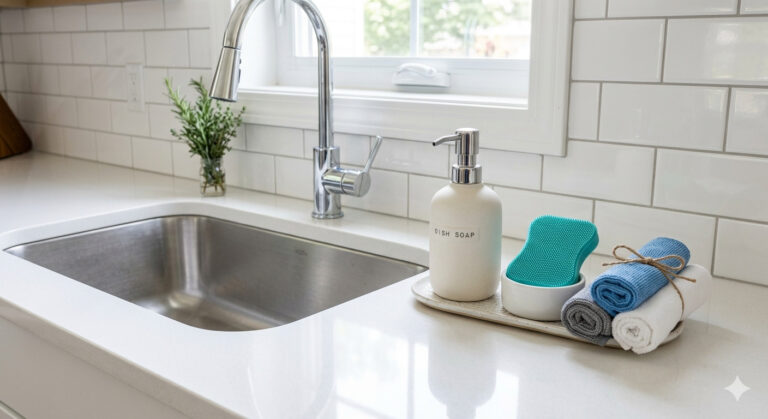
- Something practical (soap dispenser, paper towel holder)
Everything else goes in a cabinet or drawer. A clean counter changes how you feel about cooking.
Try it for one week. Leave your counter completely empty except for one or two items. Notice how much calmer you feel.
One In, One Out Rule for Life
Once you have a minimalist kitchen, protect it. Every time you bring a new tool into your kitchen, remove one old tool. Donate it. Recycle it. Throw it away.
This rule forces you to be intentional. Before buying a new gadget, you have to decide which current tool it is replacing. Most people realize they do not need the new gadget.
The only exception: replacing a broken essential. If your spatula melts, buy a new one. That is a replacement, not an addition.
FAQ: Quick Answers About Minimalist Kitchens
How many tools do I really need in a minimalist kitchen?
15 to 20 tools is plenty. That includes knives, pans, utensils, measuring tools, and storage containers. More than that is optional.
Can I have a minimalist kitchen with a family?
Yes. You might need larger quantities (bigger pot, more plates) but not more types of tools. One spatula serves four people as well as one.
What about baking? Do I need special tools?
For basic baking, you need a sheet pan, mixing bowls, measuring cups, and a whisk. That is it. Add a rolling pin and loaf pan only if you bake bread weekly.
How do I handle specialty recipes (sushi, homemade pasta, etc.)?
Borrow the specialty tool. Make a different recipe. Or buy the tool used and donate it when you are done. You do not need to own every tool for every cuisine.
Is a minimalist kitchen expensive?
No. You will buy fewer tools, but you will buy better quality. One good chef’s knife costs the same as six cheap ones. You save money in the long run.
What if I enjoy collecting kitchen tools?
Then minimalism is not for you, and that is fine. This guide is for people who feel overwhelmed by clutter and want less. Collecting is a different joy.
How do I stop people from giving me kitchen gifts?
Tell them directly: “I am trying to keep my kitchen minimal. Please do not buy me kitchen tools. I would love a consumable gift like coffee, olive oil, or a cookbook.”
Living With Less: What Changes
When you switch to a minimalist kitchen, these things happen.
You clean faster. No moving gadgets to wipe the counter. No scrubbing weird crevices. No dusting decorative items.
You cook more. Getting started is easier when you are not overwhelmed by clutter. A 5-minute meal feels doable.
You waste less food. You can see what is in your refrigerator and pantry. Nothing gets lost in the back.
You spend less money. You stop buying gadgets you do not need. You use what you have.
You feel calmer. A clean, simple space reduces stress. Your kitchen becomes a place you want to be, not a place you avoid.
The goal is not perfection. The goal is peace. Start small. Declutter one drawer today. See how it feels. Then do another tomorrow.
Which kitchen problem do you want solved next? Share your thoughts in the comments.
References: