Kitchen Measuring Tools Every Home Cook Needs: Accurate Every Time Guide
You pour what looks like a cup of flour into your mixing bowl, but your cookies come out flat and hard — and you have no idea if it was too much flour, not enough sugar, or something else entirely.
TL;DR: Consistent cooking and baking require accurate measuring. Every home cook needs dry measuring cups, a liquid measuring cup, measuring spoons, and a kitchen scale. Dry measuring cups are for flour, sugar, and grains. Liquid measuring cups are for water, milk, and oil. Measuring spoons handle small amounts of both. A kitchen scale is the most accurate tool for baking — it measures by weight, not volume. Start with cups and spoons. Add a scale if you bake often or want consistent results.
🔵 Key Takeaways
- Dry and liquid measuring cups are not interchangeable — they are designed for different ingredients.
- A kitchen scale is the only way to get truly accurate measurements, especially for baking.
- Measuring spoons should be level, not heaping, unless a recipe specifically says otherwise.
- Spoon flour into the measuring cup — scooping packs it down and adds up to 25 percent extra.
- Eye-balling measurements works for cooking but ruins baking.
The Real Causes of Measuring Mistakes and How to Fix Them
Measuring seems simple. You scoop, you pour, you cook. But there is a reason your grandmother’s cake recipe never tastes the same when you make it. The difference is not magic — it is measuring technique and the right tools.
The biggest mistake home cooks make is using the wrong type of measuring cup. A dry measuring cup is designed to be filled to the brim and leveled off. A liquid measuring cup has a spout and extra space above the line so you can see the measurement without spilling. Using a dry cup for liquid means you risk spilling. Using a liquid cup for dry means you cannot level it off properly.
The second biggest mistake is scooping flour directly from the bag with the measuring cup. That packs the flour down, adding up to 25 percent more than the recipe calls for.
Why a Kitchen Scale Changes Everything
A kitchen scale measures ingredients by weight, not volume. A cup of flour can weigh anywhere from 4 to 5.5 ounces depending on how you scoop it. A recipe developed by weight (for example, 120 grams of flour) is always accurate, no matter who makes it.
Professional bakers use scales for this reason. Home bakers who switch to a scale notice that their results become consistent every single time. No more flat cookies. No more dry cakes. No more guessing.
“Volume measurements are guesses. Weight measurements are facts. If you want your baking to turn out the same way twice, buy a kitchen scale.”
The Essential Measuring Tools Every Home Cook Needs
You do not need every measuring tool on the market. These four tools handle 100 percent of home cooking and baking.
1. Dry Measuring Cups (Nested Set)
These are for flour, sugar, rice, oats, beans, and any other dry ingredient.
What to look for:
- Metal or heavy plastic (thin plastic cracks)
- Flat rims (for leveling off with a knife)
- Sizes included: 1/4 cup, 1/3 cup, 1/2 cup, 1 cup
- Easy-to-read markings (engraved, not painted)
What to avoid:
- Cups with curved rims (hard to level)
- Loose handles that wobble
- Missing sizes (some cheap sets skip the 1/3 cup)
How to use correctly: Spoon the dry ingredient into the cup until it overflows slightly. Then scrape a straight edge (like the back of a knife) across the top to level it off. Do not scoop directly from the bag — that packs the ingredient down.
Safety reminder: Never use dry measuring cups for hot liquids. The handles are not designed for heat, and the shape makes pouring dangerous.
2. Liquid Measuring Cup (Glass or Plastic)
This is for water, milk, oil, broth, honey, and any other liquid.
What to look for:
- Glass (heat-safe, dishwasher safe, does not stain)
- Spout for pouring without dripping
- Clear markings that are easy to read
- Sizes: 1 cup (8 oz), 2 cup (16 oz), and 4 cup (32 oz) are most useful
What to avoid:
- Plastic that clouds or stains over time
- Markings that rub off
- Cups without a handle
How to use correctly: Set the cup on a flat surface. Pour liquid in. Bend down so your eye is level with the measurement line. Fill until the bottom of the liquid’s curve (the meniscus) touches the line. Do not hold the cup in the air — tilting throws off the measurement.
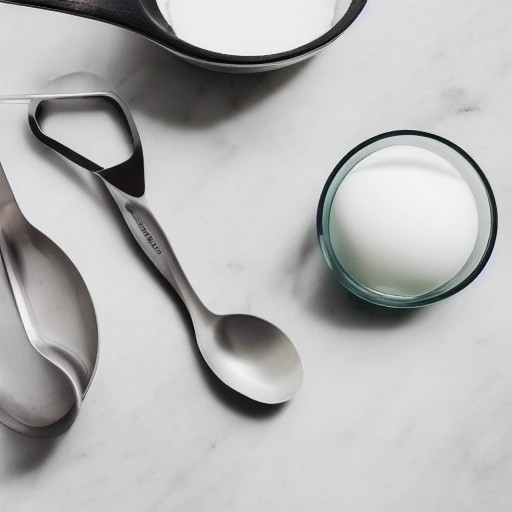
3. Measuring Spoons (Nested Set)
These are for small amounts of both dry and liquid ingredients — salt, baking powder, vanilla extract, spices, oil for sautéing.
What to look for:
- Metal (sturdy, does not warp, dishwasher safe)
- Narrow shape (fits into spice jars)
- Sizes included: 1/4 teaspoon, 1/2 teaspoon, 1 teaspoon, 1 tablespoon
- Ring to keep them together
What to avoid:
- Plastic (warp over time, especially in the dishwasher)
- Odd sizes (some sets skip 1/2 teaspoon or include useless sizes like “pinch”)
How to use correctly: For dry ingredients, dip the spoon into the container and level off with a straight edge. For liquids, fill to the brim without spilling. A heaping spoonful is not the same as a level spoonful unless the recipe says “heaping.”
4. Kitchen Scale (Digital)
This is the upgrade tool for serious home cooks and anyone who bakes. It measures ingredients by weight in grams or ounces.
What to look for:
- Digital display (easy to read)
- Tare function (resets to zero so you can add multiple ingredients to the same bowl)
- Measures in grams and ounces
- Capacity of at least 5 pounds (2,500 grams)
- Flat, smooth surface (easy to wipe clean)
What to avoid:
- Mechanical scales (harder to read accurately)
- Very cheap scales (inconsistent)
- Scales with small platforms (bowls tip over)
How to use correctly: Place your mixing bowl on the scale. Press the tare button to zero it out. Add your first ingredient until the display shows the correct weight. Press tare again. Add the next ingredient. Repeat. You can measure everything into one bowl with minimal cleanup.
Budget option: Basic digital kitchen scales cost 10 to 20 dollars. The more expensive ones (30 to 50 dollars) have better build quality and faster response times.
Comparison Table: Measuring Tools and Their Uses
| Tool | Best For | Accuracy | When to Use | Cost Range |
|---|---|---|---|---|
| Dry measuring cups | Flour, sugar, rice, oats | Good (with proper technique) | Everyday cooking, most baking | 5-15 dollars |
| Liquid measuring cup | Water, milk, oil, broth | Good | Cooking, sauces, drinks | 5-15 dollars |
| Measuring spoons | Small amounts (salt, spices, vanilla) | Good | Almost every recipe | 5-10 dollars |
| Kitchen scale | Flour, sugar, butter, chocolate, any ingredient | Excellent | Baking, portion control, consistent results | 10-50 dollars |
Chart: Accuracy Comparison by Measuring Method
Step-by-Step: How to Measure Common Ingredients Correctly
Even with the right tools, technique matters. Here is how to measure specific ingredients.
Flour
Use dry measuring cups. Spoon the flour into the cup until it is overflowing. Do not scoop. Do not tap or shake. Level off with a straight edge (knife or bench scraper).
Why: Scooping packs flour down. A scooped cup can have 25 percent more flour than a spooned cup. That extra flour makes baked goods dry and dense.
For the most accuracy: Use a kitchen scale. One cup of all-purpose flour should weigh 120 to 125 grams (4.25 to 4.5 ounces).
Granulated Sugar
Use dry measuring cups. You can scoop sugar because it does not pack down like flour. Level off with a straight edge.
Why: Sugar crystals do not compress the way flour does. Scooping is fine.
Brown Sugar
Use dry measuring cups. Pack the brown sugar firmly into the cup. Level off. The sugar should hold its shape when you turn the cup over.
Why: Brown sugar has molasses that makes it sticky. Recipes assume you pack it unless they say “lightly packed.”
Liquid Ingredients (Water, Milk, Oil)
Use a liquid measuring cup on a flat surface. Bend down so your eye is level with the line. Fill until the bottom of the liquid’s curve touches the line.
Why: Holding the cup in the air tilts it, so you cannot see the true level. The curve (meniscus) dips in the middle — read the bottom of the dip.
Sticky Liquids (Honey, Molasses, Maple Syrup)
Use a liquid measuring cup. Spray the cup with nonstick spray first. The sticky liquid will slide right out.
Why: Without spray, half the honey sticks to the cup. Your recipe ends up with less than it needs.
Small Amounts (Spices, Salt, Baking Powder, Vanilla)
Use measuring spoons. Dip into the container. Level off with a straight edge. For liquids, fill to the brim.
Why: A heaping teaspoon can be 50 percent more than a level teaspoon. Baking powder and salt are powerful — too much ruins the recipe.
Butter and Shortening
Use the markings on the butter wrapper. Most butter sticks have tablespoon markings. Cut at the line. Or use a kitchen scale.
Why: Butter wrappers are accurate. No need to dirty a measuring cup.
Nice-to-Have Measuring Tools (Buy These Second)
After you have mastered the basics, these tools solve specific problems.
Adjustable measuring cup. A cup with a plunger. Push the plunger to eject sticky ingredients like peanut butter or shortening. Costs 10 to 15 dollars.
Mini measuring spoons. Spoons for “dash,” “pinch,” and “smidgen.” Useful for very small amounts of salt or spices. Costs 5 to 8 dollars.
Measuring beakers. Tall, narrow cups for measuring small amounts of liquid. Easier to read than wide cups. Costs 8 to 12 dollars.
Milk frother pitcher. Has measurement lines for steaming milk. Useful if you make coffee drinks at home. Costs 5 to 15 dollars.
Buy these only if you regularly need them. Most home cooks never use them.
How to Measure Without Tools (When You Have To)
Sometimes you are cooking at a friend’s house or camping. These rough estimates work in a pinch.
- 1 tablespoon = size of your thumb tip (from knuckle to tip)
- 1 teaspoon = size of your fingertip
- 1/4 cup = size of a large egg
- 1/2 cup = size of a tennis ball
- 1 cup = size of a baseball or your fist
- Pinch = between your thumb and forefinger
Warning: These estimates are not accurate enough for baking. Only use them for cooking where slight differences do not matter.
Common Measuring Mistakes and How to Avoid Them
Mistake: Using dry measuring cups for liquid.
Fix: Liquid spills over the sides. Use a liquid cup with a spout.
Mistake: Scooping flour directly with the cup.
Fix: Spoon flour into the cup, then level. Or use a scale.
Mistake: Measuring over the mixing bowl.
Fix: Measure over a separate bowl or the sink. Spills ruin the recipe.
Mistake: Eye-balling teaspoon amounts.
Fix: Use measuring spoons. Your eye is not that accurate.
Mistake: Not leveling off dry ingredients.
Fix: Always scrape across the top with a straight edge.
Mistake: Holding liquid cups in the air.
Fix: Set the cup on a flat surface. Bend down to eye level.
FAQ: Quick Answers About Measuring Tools
Do I really need both dry and liquid measuring cups?
Yes. They are designed differently. Using dry cups for liquid leads to spills. Using liquid cups for dry means you cannot level them off.
What is the most important measuring tool for baking?
A kitchen scale. Weight measurements are always accurate. Volume measurements vary based on how you scoop.
Can I use a kitchen scale for everything?
Yes. Most recipes list volume measurements (cups), but you can look up weight equivalents online. Many modern cookbooks include both.
How do I measure brown sugar correctly?
Pack it firmly into a dry measuring cup. Level off. The sugar should hold its shape when you turn the cup over.
Do I need to measure spices exactly?
For baking, yes. Too much baking powder or salt ruins the recipe. For cooking, you can be more flexible.
What is the tare button on a kitchen scale?
It resets the scale to zero. Place your bowl on the scale. Press tare. Add ingredients. The scale shows only the ingredient weight, not the bowl.
How do I clean measuring spoons with narrow handles?
Wash by hand with a narrow bottle brush. Or put them in the dishwasher on the top rack. Narrow handles trap food in the hinge.
Building Your Measuring Tool Collection Over Time
You do not need to buy everything at once. Here is a realistic timeline.
Week 1: Buy dry measuring cups, liquid measuring cup, and measuring spoons. Spend 15 to 30 dollars total.
Month 1: Cook and bake with these tools. Practice proper technique. Notice if you struggle with any measurements.
Month 3: If you bake at least once a week, buy a kitchen scale (10 to 20 dollars). You will notice immediate improvement in your results.
Month 6: If you bake bread or pastries often, upgrade to a nicer scale with a larger platform and faster response time (30 to 50 dollars).
Year 1: Replace any plastic cups or spoons that have warped. Upgrade to metal if you prefer.
Start simple. Add tools only when you need them. A beginner does not need a 50-dollar scale. A weekly baker does.
Which kitchen problem do you want solved next? Share your thoughts in the comments.
References: