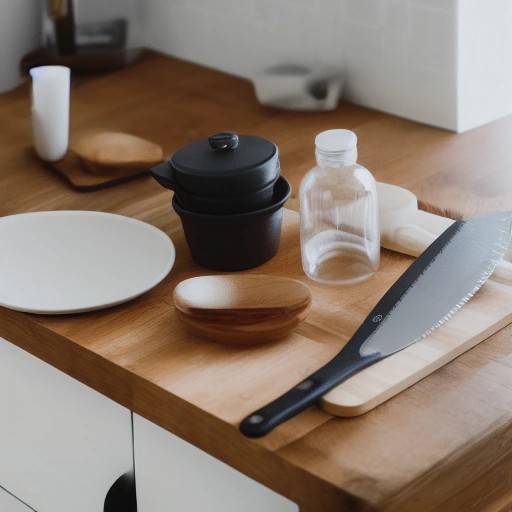
Everyday Kitchen Essentials That Actually Get Used: No Drawer-Fillers Allowed
You open your kitchen drawer and see a melon baller, a strawberry stemmer, and an electric can opener — none of which you have touched in the past two years — while the spatula you actually need is buried somewhere underneath.
TL;DR: Most kitchens are full of gadgets that seemed useful but never get used. The essentials that actually get used daily are a chef’s knife, cutting board, large skillet, medium pot, spatula, wooden spoon, colander, sheet pan, mixing bowls, measuring cups, and a few basic utensils. That is it. Everything else is optional. Buy these first. Use them for months. Only add a new tool when you have wished for it at least five times. This approach saves money, saves drawer space, and makes cooking easier.
🔵 Key Takeaways
- The average home cook uses only about 20 percent of the tools in their kitchen regularly.
- A chef’s knife, cutting board, and skillet handle 80 percent of daily cooking tasks.
- Unitaskers (tools that do one thing) almost never earn their drawer space.
- Buy quality for the items you touch every day — knife, skillet, spatula.
- Save money on everything else — measuring cups, mixing bowls, colander.
The Real Difference Between Essentials and Clutter
Walk into any kitchen supply store and you will see hundreds of gadgets. Garlic presses. Avocado slicers. Herb strippers. Egg separators. Banana hangers. Each one looks clever. Each one promises to save time. Each one ends up in a drawer, used twice, then forgotten.
The problem is not that these gadgets are bad. The problem is that they replace skills you already have. Your chef’s knife minces garlic in five seconds. Your hands separate eggs in two seconds. Your fingers strip herbs off the stem in three seconds.
The everyday essentials are the tools that work for almost every task. Everything else is a solution looking for a problem.
Why Unitaskers Are the Enemy of an Organized Kitchen
A unitasker is a tool that does exactly one thing. An apple corer cores apples. A garlic press presses garlic. A strawberry stemmer stems strawberries. These tools take up space, cost money, and break eventually. And they only help with one specific ingredient.
A multitasker does dozens of things. A chef’s knife cores apples, presses garlic (smash with the flat side), and stems strawberries (cut the top off). One tool. Infinite uses. No drawer space wasted.
“Before you buy any kitchen tool, ask yourself: Can my chef’s knife do this? If the answer is yes, put the gadget back on the shelf.”
The Everyday Essentials That Actually Get Used
These tools earn their spot in your kitchen every single day. Start here.
1. Chef’s Knife (8-inch)
You will use this more than any other tool in your kitchen. Chopping onions, slicing vegetables, cutting meat, smashing garlic, mincing herbs. An 8-inch chef’s knife is the right size for most hands.
What to look for:
- Forged construction (stronger than stamped)
- Full tang (metal runs through the handle)
- Comfortable grip (hold it before buying)
- Good beginner brands: Victorinox, Mercer, J.A. Henckels
How often used: Every single day you cook.
Safety reminder: A dull knife is more dangerous than a sharp one. Dull knives slip. Learn to use a honing steel or pull-through sharpener. Hand wash your knife — dishwashers ruin the blade and handle.
2. Cutting Board
Your chef’s knife needs a good partner. A cutting board protects your knife and gives you room to work.
What to look for:
- Wood or bamboo (gentle on knife edges)
- At least 12 inches by 18 inches (big enough for most tasks)
- Thick enough not to slide
How often used: Every single day you cook.
Buy two cutting boards if you cook meat. One for raw meat (use a plastic board that can go in the dishwasher). One for everything else.
3. Large Skillet (10 or 12 inches)
Eggs, stir-fry, searing meat, sautéing vegetables, frying pancakes, making grilled cheese. Your skillet is the workhorse of your stovetop.
What to look for:
- Nonstick for beginners (easy to clean, food does not stick)
- Oven-safe to 400 degrees
- Comfortable, heatproof handle
How often used: Almost every day.
Note: Nonstick pans wear out after two to three years. That is normal. Do not spend a lot of money on nonstick — they all wear out.
4. Medium Pot (3 to 4 quarts)
Boiling pasta, cooking rice, making soup, simmering sauce, steaming vegetables. A medium pot handles almost everything a pot needs to do.
What to look for:
- Stainless steel (durable, heats evenly)
- Lid that fits tightly
- Heatproof handle
How often used: Several times per week.
5. Spatula (Slotted and Solid)
You need to flip food. You need to lift food. You need to turn food. A spatula does all of this.
What to look for:
- Heat-resistant silicone or nylon (safe for nonstick pans)
- Slotted spatula (lets oil drain through)
- Solid spatula (for pancakes, eggs, fish)
How often used: Almost every day.
What to avoid: Metal spatulas on nonstick pans. They scratch the coating.
6. Wooden Spoon
Simple. Cheap. Indestructible. A wooden spoon stirs sauces, breaks up ground meat, scrapes browned bits from the pan, and never scratches your cookware.
What to look for:
- One-piece wood (no separate handle to break)
- Smooth surface (sanded, not rough)
- Long enough to keep your hand away from heat
How often used: Almost every day.
7. Colander
Draining pasta, rinsing vegetables, washing fruit, straining canned beans. A colander is simple but essential.
What to look for:
- Sturdy base (does not tip over)
- Small feet (allows water to drain underneath)
- Dishwasher safe
How often used: Several times per week.
8. Sheet Pan (Rimmed Baking Sheet)
Roasted vegetables, sheet pan dinners, cookies, bacon in the oven, cooling cookies, toasting nuts. A rimmed sheet pan is incredibly versatile.
What to look for:
- Rimmed edges (so juices do not drip off)
- 18 inches by 13 inches (standard half-sheet size)
- Heavy gauge (warp-resistant)
How often used: Several times per week.
9. Mixing Bowls (Set of Three)
Mixing ingredients, holding prepped vegetables, marinating meat, serving salad, storing leftovers temporarily.
What to look for:
- Nesting set (they store inside each other)
- Glass or stainless steel (both durable)
- At least three sizes: small, medium, large
How often used: Several times per week.
10. Measuring Cups and Spoons
Cooking requires some accuracy. Baking requires exact accuracy. You need both dry and liquid measuring cups plus measuring spoons.
What to look for:
- Dry measuring cups: metal or heavy plastic, nested set (1/4, 1/3, 1/2, 1 cup)
- Liquid measuring cup: glass, 2-cup size, clear markings
- Measuring spoons: metal, nested set (1/4 tsp, 1/2 tsp, 1 tsp, 1 Tbsp)
How often used: Almost every time you cook or bake.
11. Tongs (One Good Pair)
Tongs are like an extension of your hand. Use them to flip meat, toss salad, serve pasta, turn vegetables, grab hot items from a steamer.
What to look for:
- Scissor-style with a locking mechanism
- Silicone tips (safe for nonstick pans)
- Stainless steel body
How often used: Several times per week.
12. Vegetable Peeler
Peeling carrots, potatoes, apples, cucumbers. A good peeler makes the job fast and safe.
What to look for:
- Y-peeler style (easier to control than straight peeler)
- Sharp blade
- Comfortable grip
How often used: Several times per week.
13. Can Opener
You will open canned tomatoes, beans, broth, tuna, and coconut milk regularly. A simple manual can opener does the job.
What to look for:
- Manual (electric ones break and take up counter space)
- Smooth-turning mechanism
- Rubber-coated handles for grip
How often used: Several times per week.
14. Kitchen Shears (Scissors)
Cutting herbs, snipping chicken, opening packaging, trimming fat, cutting pizza. Kitchen shears are scissors designed for food.
What to look for:
- Come apart for cleaning (food gets trapped in the hinge)
- Sturdy blades
- Comfortable handles
How often used: Several times per week.
15. Storage Containers (One Matching Set)
Leftovers need a home. A matching set of glass or plastic containers with lids saves space and reduces frustration.
What to look for:
- One brand and size range (so lids are interchangeable)
- Clear (so you can see what is inside)
- Stackable
How often used: Every day.
Comparison Table: Daily Drivers vs. Drawer Fillers
| Daily Driver (Buy This) | Drawer Filler (Skip This) | Why the Drawer Filler Is a Waste |
|---|---|---|
| Chef’s knife | Avocado slicer | Your knife slices avocado in 5 seconds |
| Wooden spoon | Electric stirring device | Your hand and a spoon work fine |
| Colander | Salad spinner | Spin dry with a towel or let air dry |
| Chef’s knife | Egg separator | Crack egg into your hand; let white run through fingers |
| Large skillet | Electric pancake griddle | Your skillet makes pancakes just fine |
| Mixing bowls + spoon | Electric stand mixer (for beginners) | Start with your arm; buy mixer later if you bake weekly |
| Chef’s knife | Garlic press | Smash garlic with knife side; mince in 5 seconds |
| Tongs | Specialty barbecue fork | Tongs flip everything a fork can, plus more |
| Can opener (manual) | Electric can opener | Manual is faster, cheaper, never breaks |
| Vegetable peeler | Electric peeler | Electric peeler takes longer to set up than to use |
Chart: Usage Frequency of Kitchen Tools
How to Choose Quality Without Overspending
You do not need to spend a fortune. But you should not buy the cheapest option for tools you use every day.
Spend money on:
- Chef’s knife (40 to 70 dollars for a good beginner knife)
- Large skillet (25 to 40 dollars for nonstick)
- Tongs and spatula (10 to 15 dollars each for heat-resistant silicone)
Save money on:
- Measuring cups and spoons (5 to 10 dollars total)
- Mixing bowls (15 to 20 dollars for a set)
- Colander (5 to 10 dollars)
- Wooden spoon (2 to 5 dollars)
- Can opener (5 to 10 dollars)
- Vegetable peeler (3 to 8 dollars)
Never buy the cheapest:
- Chef’s knife (a 5-dollar knife is dangerous — it slips and does not cut well)
- Cutting board (the thinnest boards warp and slide)
- Sheet pan (cheap pans warp in the oven and food slides to one side)
Restaurant supply stores are great for affordable, durable tools. No fancy branding. Just stuff that works.
The “One In, One Out” Rule for Kitchen Tools
Once you have your essentials, use this rule to keep your kitchen from getting cluttered again.
Every time you buy a new kitchen tool, get rid of an old one. Donate it. Recycle it. Throw it away if it is broken.
This rule forces you to be intentional. Before buying a garlic press, you have to decide which current tool to remove. Most people realize they would rather keep the tool they have.
The only exception: replacing a broken essential. If your spatula melts, buy a new one. That is a replacement, not an addition.
Renter-Friendly and Small Kitchen Tips
If you have a small kitchen or rent an apartment, these essentials still work. You just need to store them wisely.
Use a magnetic knife strip. Mount it on the wall or backsplash. Knives are accessible and off the counter. No knife block needed.
Store sheet pans vertically. Use a divider or tension rods inside a narrow cabinet. Stacking them flat wastes space.
Hang your most-used tools. Install a small pegboard or wall rail. Hang spatulas, tongs, and wooden spoons. They are within reach and do not crowd drawers.
Nest your mixing bowls. Buy nesting bowls that fit inside each other. They take up almost no space.
Use drawer dividers. Keep utensils organized with inexpensive bamboo or plastic dividers. No more digging through a jumbled drawer.
For renters, use adhesive hooks and tension rods. No drilling required.
FAQ: Quick Answers About Everyday Kitchen Essentials
What is the one tool every kitchen must have?
A chef’s knife. You cannot cook effectively without a good knife. Everything else is secondary.
How many kitchen tools do I actually need?
The list above has 15 essentials. Most home cooks can do everything with these 15 tools. Everything beyond that is optional.
Should I buy a knife block?
No. Buy a magnetic strip or in-drawer knife holder. Knife blocks take up counter space and encourage you to buy knives you do not need.
What is the biggest waste of money in kitchen tools?
Electric gadgets. Electric can openers, electric knife sharpeners, electric choppers. They break, take up space, and do the job slower than your hands.
How do I know if a tool is worth buying?
Ask yourself: Have I wished for this tool at least five times in the past month? If yes, buy it. If no, skip it.
Can I use the same cutting board for meat and vegetables?
Yes, but wash with hot soapy water between uses. Better yet, use separate boards: one plastic board for raw meat (dishwasher safe), one wood or bamboo board for everything else.
How often should I replace kitchen tools?
Replace nonstick pans every 2 to 3 years (when coating scratches). Replace wooden spoons when they crack or get fuzzy. Replace chef’s knife only when it will not hold an edge anymore — good knives last decades.
A Complete Starter Shopping List
Here is exactly what to buy with approximate prices.
| Tool | Good Beginner Option | Approximate Cost |
|---|---|---|
| Chef’s knife (8-inch) | Victorinox Fibrox Pro | 45 dollars |
| Cutting board | Bamboo, 12×18 inches | 12 dollars |
| Large skillet (10-12 in) | T-fal nonstick | 25 dollars |
| Medium pot (3-4 qt) | Farberware stainless steel | 25 dollars |
| Spatula (slotted + solid) | Silicone 2-pack | 10 dollars |
| Wooden spoon | Single, one-piece | 4 dollars |
| Colander | Basic plastic or metal | 7 dollars |
| Sheet pan | Nordic Ware half-sheet | 16 dollars |
| Mixing bowls (set of 3) | Stainless steel nesting | 18 dollars |
| Dry measuring cups | Basic metal set | 8 dollars |
| Liquid measuring cup | Glass 2-cup | 8 dollars |
| Measuring spoons | Metal nested set | 6 dollars |
| Tongs | Silicone-tipped, locking | 10 dollars |
| Vegetable peeler | Y-peeler | 5 dollars |
| Can opener | Manual, smooth turn | 7 dollars |
| Kitchen shears | Dishwasher-safe | 10 dollars |
| Storage containers | Glass or plastic matching set | 20 dollars |
| Total | 236 dollars |
You do not need to buy everything at once. Start with the first 10 items (about 170 dollars). Add the rest over the next few months as you need them.
Which kitchen problem do you want solved next? Share your thoughts in the comments.
References: