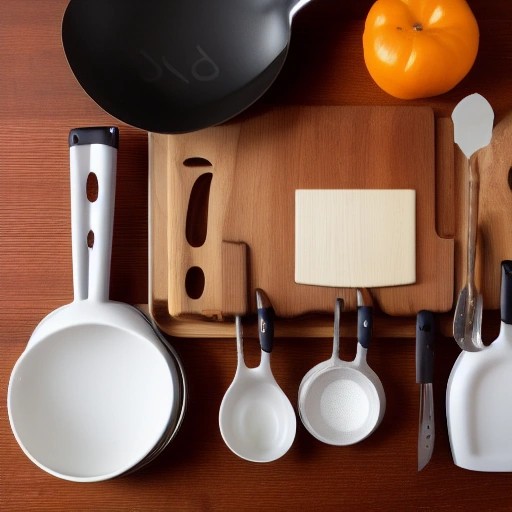
Kitchen Tools and Gadgets Beginners Actually Need: The No-Fluff Starter Guide
You walk into a kitchen supply store, and suddenly you are staring at avocado slicers, garlic presses, electric wine openers, and something called a “banana protector” — and you have no idea what you actually need to cook a real meal.
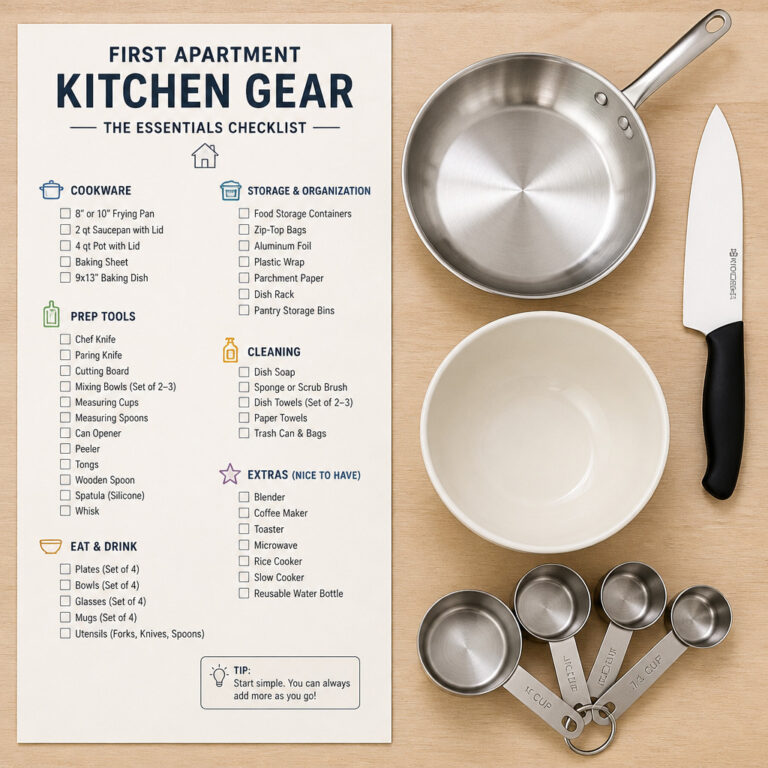
TL;DR: Beginners do not need 90 percent of the gadgets sold in kitchen stores. You need a chef’s knife, a cutting board, a medium pot, a large skillet, a spatula, a wooden spoon, measuring cups and spoons, a mixing bowl, a colander, and a sheet pan. That is it. These ten tools let you make eggs, pasta, stir-fry, soup, roasted vegetables, rice, and dozens of other meals. Buy the best quality you can afford for the knife and skillet — everything else can be budget-friendly. Add tools slowly as you find yourself wishing you had them.
🔵 Key Takeaways
- A chef’s knife is the most important tool in your kitchen — buy the best one you can afford.
- Nonstick skillets are great for beginners because food does not stick and cleaning is easy.
- You do not need a full knife block — a chef’s knife, paring knife, and serrated knife are enough.
- Avoid unitaskers (tools that do only one thing) like avocado slicers and egg separators.
- Buy tools as you need them, not before. If you cook for a month without wishing for a gadget, you do not need it.
The Real Causes of Kitchen Gadget Overwhelm and How to Avoid Them
Kitchen tool shopping is overwhelming because stores want you to believe you need everything. The avocado slicer looks clever. The garlic press promises to save time. The electric can opener seems convenient. But most of these gadgets end up in a drawer, used twice, then forgotten.
The truth is that home cooking requires very few tools. Professional chefs cook amazing food with a knife, a pan, and a pot. Everything else is optional.
Start with the basics. Cook for a few months. Then buy one new tool at a time only when you find yourself saying, “I really wish I had a tool that could do X.” That is how you build a useful kitchen, not a cluttered one.
Why “Buy a Knife Block” Is Bad Advice
Knife blocks look nice on the counter. But they come with eight to twelve knives, and you will use only two or three of them regularly. The rest will sit there, taking up space, never getting sharpened.
Instead, buy three individual knives and a magnetic strip or in-drawer knife holder. You will save money, save counter space, and actually use what you own.
“The most expensive kitchen gadget is the one you buy and never use. Start small. Add slowly. Your wallet and your drawer space will thank you.”
The Essential 10: Tools Beginners Actually Need
These ten tools let you cook 90 percent of beginner-friendly recipes. Buy these first. Ignore everything else until you have cooked for at least three months.
1. Chef’s Knife (8-inch)
This is your workhorse. You will use it for chopping onions, slicing vegetables, cutting meat, and smashing garlic cloves. An 8-inch chef’s knife is the right size for most hands.
What to look for:
- Forged, not stamped (forged knives are stronger)
- Full tang (the metal runs through the handle)
- Comfortable grip (hold it before buying)
- Good brands for beginners: Victorinox, Mercer, J.A. Henckels (entry level)
What to avoid:
- Glass cutting boards (they dull knives instantly)
- Dishwasher (hand wash only)
- Super expensive knives for your first one (start under 50 dollars)
Budget option: Victorinox Fibrox Pro 8-inch chef’s knife costs about 45 dollars and is used by professional cooks.
2. Cutting Board
You need a surface that protects your knife and gives you room to chop.
What to look for:
- Wood or bamboo (gentle on knives)
- At least 12 inches by 18 inches (big enough for most tasks)
- Thick enough not to slide (or put a damp paper towel under it)
What to avoid:
- Glass cutting boards (destroy knife edges)
- Tiny boards (frustrating for chopping onions)
Budget option: Bamboo cutting board from a discount store costs 10 to 15 dollars.
Safety reminder: Never cut raw meat and then vegetables on the same board without washing with hot soapy water between uses. Better yet, use separate boards for meat and produce.
3. Medium Pot (3 to 4 quarts)
You need a pot for boiling pasta, making rice, cooking soup, and simmering sauces.
What to look for:
- Stainless steel (durable, heats evenly)
- Lid that fits tightly
- Heatproof handle
What to avoid:
- Thin, cheap pots (hot spots burn food)
- Pots without lids (you will need a lid)
Budget option: Farberware or T-fal stainless steel pot costs 20 to 30 dollars.
4. Large Skillet (10 or 12 inches)
You will use this almost every day. Eggs, stir-fry, searing meat, sautéing vegetables, frying pancakes.
What to look for:
- Nonstick for beginners (easier to clean, less sticking)
- Oven-safe to 400 degrees (if you want to finish cooking in the oven)
- Comfortable handle
What to avoid:
- Metal utensils on nonstick (use silicone, wood, or plastic)
- Dishwasher (hand wash nonstick pans)
Budget option: T-fal nonstick skillet costs 20 to 30 dollars.
Note: Nonstick pans wear out after two to three years. That is normal. Do not buy an expensive nonstick pan — they all wear out.
5. Spatula (Slotted and Solid)
You need at least one spatula for flipping and turning food.
What to look for:
- Heat-resistant silicone or nylon (safe for nonstick pans)
- Slotted spatula (lets oil drain through)
- Solid spatula (for pancakes and eggs)
Budget option: Two-pack of silicone spatulas costs 8 to 12 dollars.
What to avoid:
- Metal spatulas on nonstick pans (scratches the coating)
- Very flimsy spatulas (they bend instead of flipping)
6. Wooden Spoon
Simple. Cheap. Indestructible. A wooden spoon stirs sauces, breaks up ground meat, scrapes browned bits from the pan, and does not scratch your cookware.
What to look for:
- One-piece wood (no separate handle that can break)
- Smooth surface (sanded, not rough)
- Long enough to keep your hand away from heat
Budget option: A single wooden spoon costs 2 to 5 dollars.
7. Measuring Cups and Spoons
Cooking requires accuracy. Baking requires exact accuracy. You need both.
What to look for:
- Dry measuring cups (nested set, sizes 1/4 cup, 1/3 cup, 1/2 cup, 1 cup)
- Liquid measuring cup (glass or plastic, 2-cup size)
- Measuring spoons (nested set, 1/4 tsp, 1/2 tsp, 1 tsp, 1 Tbsp)
Budget option: Basic plastic or metal sets cost 5 to 10 dollars total.
8. Mixing Bowls (Set of Three)
You need bowls for mixing ingredients, holding prepped vegetables, marinating meat, and serving salad.
What to look for:
- Nesting set (they store inside each other)
- Glass or stainless steel (both are durable)
- At least three sizes: small, medium, large
Budget option: Stainless steel nesting bowls cost 15 to 25 dollars.
9. Colander
You need to drain pasta, rinse vegetables, and wash fruit.
What to look for:
- Sturdy base (so it does not tip over)
- Small feet (allows water to drain underneath)
- Dishwasher safe
Budget option: Basic plastic or metal colander costs 5 to 10 dollars.
10. Sheet Pan (Rimmed Baking Sheet)
Roasted vegetables, sheet pan dinners, cookies, bacon in the oven, cooling cookies.
What to look for:
- Rimmed edges (so juices do not drip off)
- 18 inches by 13 inches (standard half-sheet size)
- Heavy gauge (warp-resistant)
Budget option: Nordic Ware half-sheet pan costs 15 to 20 dollars and lasts for years.
Comparison Table: Beginner Tools vs. Gadgets You Do Not Need
| Essential Tool | Why You Need It | Gadget to Avoid | Why You Do Not Need It |
|---|---|---|---|
| Chef’s knife | Does 90% of cutting | Avocado slicer | Your chef’s knife slices avocado in 5 seconds |
| Wooden spoon | Stir, scrape, sauté | Electric stirring device | Your hand and a spoon work fine |
| Colander | Drain pasta, rinse veg | Salad spinner | Spin dry with a towel or let air dry |
| Measuring cups | Accurate portions | Egg separator | Crack egg into your hand, let white run through fingers |
| Skillet | Fry, sear, sauté | Electric pancake griddle | Your skillet makes pancakes just fine |
| Mixing bowls | Mix, prep, serve | Electric stand mixer | Start with a spoon and your arm |
| Spatula | Flip food | Tongs (for now) | A spatula flips. Buy tongs later if you need them. |
| Sheet pan | Roast, bake | Silicone baking mat | Parchment paper works great |
Chart: Beginner Kitchen Tool Priority
Nice-to-Have Tools (Buy These Second)
After you have cooked for a few months with the essential ten, add these one at a time when you find yourself needing them.
Paring knife. A small knife for peeling apples, deveining shrimp, or cutting small vegetables. Costs 10 to 20 dollars.
Serrated knife (bread knife). For cutting bread, tomatoes, and cakes without crushing them. Costs 15 to 25 dollars.
Can opener. A simple manual can opener. Costs 5 to 10 dollars. (Do not buy an electric one — it breaks and takes up counter space.)
Vegetable peeler. For peeling carrots, potatoes, and apples. Costs 3 to 8 dollars. A Y-peeler is often easier to hold than a straight peeler.
Kitchen shears (scissors). For cutting herbs, snipping chicken, opening packaging. Costs 10 to 15 dollars. Look for shears that come apart for cleaning.
Whisk. For making scrambled eggs, salad dressing, gravy, and whipped cream. Costs 5 to 10 dollars.
Thermometer. An instant-read thermometer takes the guesswork out of meat and bread baking. Costs 10 to 20 dollars.
Buy these one at a time. Do not buy the whole list at once. You will realize which ones you actually miss.
Tools Beginners Do NOT Need (Save Your Money)
These gadgets are sold everywhere, but beginners do not need them. Skip them completely or borrow one before buying.
Garlic press. Mince garlic with your chef’s knife. It takes 10 seconds.
Electric can opener. Manual can openers are faster, cheaper, and never break.
Food processor. Start with a knife and a bowl. Buy a food processor only if you cook for a crowd or make hummus weekly.
Stand mixer. A hand mixer or a wooden spoon works for almost everything. Stand mixers are expensive and take up counter space.
Air fryer. Your oven and a sheet pan do the same thing. An air fryer is just a small convection oven.
Instant Pot. A pot and a skillet handle most pressure cooker recipes. Buy an Instant Pot only if you cook beans from dry or tough meats often.
Bread machine. Make bread by hand. It is not hard, and your kitchen smells amazing.
Specialty gadgets. Egg separators, strawberry stemmers, banana slicers, avocado tools — all useless. Your knife and your hands do these jobs.
If you really want one of these gadgets, ask to borrow a friend’s first. Use it for a week. Most people discover they do not need their own.
How to Choose Quality Without Overspending
You do not need to spend a lot of money on kitchen tools. But you also should not buy the cheapest possible option for certain items.
Spend money on: Chef’s knife, large skillet (if nonstick), sheet pan (heavy gauge)
Save money on: Wooden spoon, spatula, measuring cups, mixing bowls, colander
Never buy the cheapest: Chef’s knife (the 5-dollar knife is dangerous — it slips and does not cut well), cutting board (the thinnest ones warp and slide)
A good rule: Buy the second-cheapest option in a store. The cheapest is often poorly made. The most expensive is often overkill for a beginner. The second-cheapest is usually good quality at a fair price.
Check restaurant supply stores. They sell durable, no-frills tools at low prices. No fancy branding. Just stuff that works.
Building Your Kitchen Over Time
You do not need to buy everything at once. Here is a realistic timeline.
Month 1: Buy the essential ten. Spend about 150 to 200 dollars total.
Month 2: Cook for a month. Notice what frustrates you.
Month 3: Buy one or two nice-to-have tools based on your frustrations (maybe a paring knife, maybe a whisk, maybe a thermometer).
Month 6: Buy one specialty tool if you have cooked a specific dish ten times and wished for it each time.
Year 1: Replace anything that broke or wore out with a better version.
This approach saves you money and drawer space. You will not have gadgets you never use. Everything in your kitchen will earn its place.
FAQ: Quick Answers About Beginner Kitchen Tools
What is the one tool every beginner must buy first?
An 8-inch chef’s knife and a cutting board. You cannot cook without these. Everything else is secondary.
How much should a beginner spend on kitchen tools?
150 to 200 dollars for the essential ten. Then add tools as needed. Do not spend 500 dollars before you have cooked a single meal.
Do I need nonstick pans as a beginner?
Yes, for your first skillet. Nonstick is forgiving. Food does not stick. Cleaning is easy. Buy a good nonstick skillet for 20 to 30 dollars.
How do I keep my chef’s knife sharp?
Buy a pull-through sharpener (10 to 15 dollars) or a honing steel (15 to 20 dollars). Learn to use it. A dull knife is dangerous — it slips more easily than a sharp one.
Can I use metal utensils on nonstick pans?
No. Metal scratches nonstick coating. Use silicone, wood, or nylon. Your wooden spoon and silicone spatula are perfect.
What is the biggest waste of money for beginners?
Electric gadgets. Electric can openers, electric knife sharpeners, electric choppers. They break, take up space, and do the job slower than your hands.
How do I know when to replace a tool?
When the nonstick coating is scratched (replace immediately — the coating can flake into food). When the knife no longer holds an edge. When the spatula melts or bends. When the pot has hot spots that burn food.
A Sample Starter Shopping List
Here is exactly what to buy with approximate prices.
| Tool | Good Beginner Option | Approximate Cost |
|---|---|---|
| Chef’s knife (8-inch) | Victorinox Fibrox Pro | 45 dollars |
| Cutting board | Bamboo, 12×18 inches | 12 dollars |
| Medium pot (3-4 qt) | Farberware stainless steel | 25 dollars |
| Large skillet (10-12 in) | T-fal nonstick | 25 dollars |
| Spatula (slotted + solid) | Silicone 2-pack | 10 dollars |
| Wooden spoon | Single, one-piece | 4 dollars |
| Measuring cups and spoons | Basic plastic set | 8 dollars |
| Mixing bowls (set of 3) | Stainless steel | 18 dollars |
| Colander | Basic plastic or metal | 7 dollars |
| Sheet pan | Nordic Ware half-sheet | 16 dollars |
| Total | 170 dollars |
These prices are estimates and may vary by store and sales. You can find cheaper options at discount stores or thrift shops. You can also spend more for premium brands if you have the budget.
Which kitchen problem do you want solved next? Share your thoughts in the comments.
References: